How Airspace Closures Affect the Entire World
A closed sky over one region can strand travellers continents away. How FIRs, NOTAMs, hubs, crews, slots and cargo carry the shock worldwide.

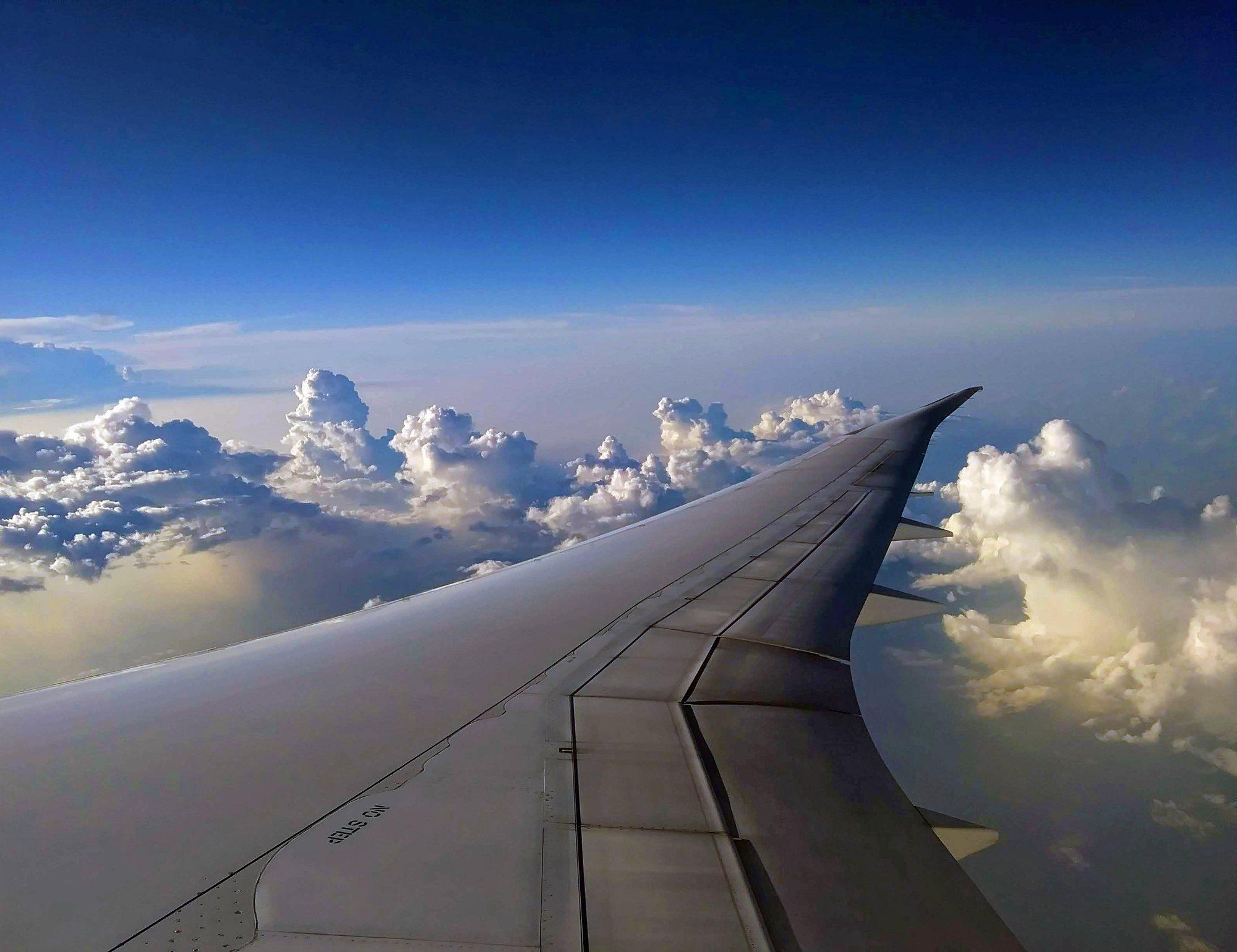
Photo: Daniel Case · CC BY-SA 4.0
On this page
In the first days of March 2026, about 58,000 Indonesians on pilgrimage were stranded in Saudi Arabia and thousands of travellers were stuck on Bali, the Associated Press reported. The travellers on Bali were thousands of kilometres from the fighting that began over Iran on 28 February. They, like the pilgrims, were caught in the knock-on effects of airspace closures over the Gulf, which within hours cut off some of the busiest connecting hubs on the planet. This explainer sets the politics aside and looks at the machinery: how the sky is divided and closed, why a detour costs more than the extra miles, and how one gap in the map travels through hubs, aircraft, crews, airport slots, cargo and the finances of air traffic control. For the conflicts themselves, see our companion piece on how global conflicts are disrupting air travel.
The Sky Has Borders: FIRs, NOTAMs and Advisories#
The world's airspace is divided into flight information regions, or FIRs, each identified by a four-letter code and looked after by a designated air traffic services authority. Over land, FIRs mostly follow national borders, so Iran's airspace is essentially FIR Tehran, coded OIIX. Over the high seas, states take responsibility for large oceanic regions by international agreement.
Changes to that airspace are announced through NOTAMs: notices to airmen (or notices to air missions, in the US), which pilots and dispatchers must check before every flight. In practice, a national closure is published as a NOTAM. The Ukrainian notice cited in EASA's latest bulletin on Ukraine, A0021/26, declares the Lviv, Kyiv, Dnipro, Simferopol and Odesa FIRs closed to civil flights.
A second layer sits on top: advice from other governments to their own airlines. ICAO says assessing safety in conflict zones is the responsibility of states, and many publish their own warnings. EASA's Conflict Zone Information Bulletins can be strikingly precise. Its Gulf bulletin, extended on 30 September 2026, advises airlines not to fly over the waters of the Persian Gulf within the Bahrain, Kuwait, Qatar and UAE FIRs except to arrive or depart, and not to cross the Gulf of Oman west of 58° East, while urging caution over land. Its Saudi bulletin draws a no-go zone along lines joining named navigation waypoints.
The upshot is that the sky airlines actually avoid is often larger than any official closure. Airspace can be legally open and still empty of most foreign airliners, because their regulators or their own risk teams have ruled it out.
Why a Detour Costs More Than the Extra Miles#
Airlines plan long-haul flights along great circles, the shortest path between two points on a sphere. On a flat map these routes look curved, which is why flights between Europe and East Asia used to arc across Siberia. Remove a block of airspace and the shortest legal path can become much longer. Finnair says its Asian routings are up to 40% longer than before Russian airspace closed in 2022. Because it still reports traffic using great-circle distances, Finnair notes that its capacity for July to September 2026 would have been about 15% higher if measured over the routes actually flown.
The cost grows faster than the distance. An aircraft must carry the extra fuel for a detour, and carrying that extra weight burns more fuel still. On the longest routes, an airline may have to take fewer passengers or bags, or stop to refuel. On 1 March 2026, as closures spread across the Middle East, Air India's New York JFK and Newark flights were due to make a technical stop in Rome, according to Aerospace Global News; the airline was already barred from Pakistani airspace.
Twin-engine jets face a further constraint, set out in the box below. ETOPS approvals allow much longer diversion times than the basic rule, but every route must still be planned around usable diversion airports. When airspace closes, airports inside or near it can drop off that list. In late October, OPSGROUP's Safe Airspace service reported that Riyadh's main airport had partly reopened after attacks but was still not usable as an alternate.
When a Hub Goes Dark#
Much long-haul travel runs through hubs. There, an airline schedules waves, or "banks", of arriving flights followed by waves of departures, so passengers from dozens of cities can connect within an hour or two. The design is efficient, but it concentrates risk. Dubai International handled a record 95.2 million passengers in 2025, according to the AP. When Qatar closed its airspace on 28 February and UAE air traffic was suspended, the banks at Doha, Dubai and Abu Dhabi stopped at once, stranding passengers whose journeys began and ended far from the Gulf. By 6 March, Cirium estimated that about 23,000 flights had been cancelled since late February, and Emirates was rebuilding towards about 60% of its network, Al Jazeera reported.
Traffic then looks for other paths. In June, IATA said that African hub carriers were gaining traffic as flows shifted away from the Middle East, and that direct Europe–Asia flights bypassing the Gulf were winning some too. Finnair reported that the disruption had reduced Europe–Asia transfer capacity, supporting its load factors and yields in the third quarter. Months later, the rebuild is still uneven:
| Flights between Europe and the Middle East | Level compared with pre-crisis (Jan–Feb 2026) |
|---|---|
| Emirates, Etihad and Qatar Airways | About 23% below |
| European airline groups | About 82% below |
| Israeli carriers | 56% above |
Source: EUROCONTROL European Aviation Overview, week of 5–11 October 2026. Year to date, all Europe–Middle East traffic was 14% below 2025.
Aircraft, Crews and Slots: The Domino Chain#
A long-haul aircraft's schedule is a chain of flights. If a detour adds an hour, the aircraft arrives late for its next departure and the delay travels with it. Airlines usually respond by writing the longer flight time into the timetable, which can mean the same aircraft no longer fits its old rotation, so more aircraft are needed to fly the same schedule.
Crews add a second chain. Duty-time limits cap how long pilots and cabin crew may work, so a route stretched beyond those limits needs a larger crew or a stop to swap crews. When Air India costed the Pakistani ban for the Indian government in 2025, it listed additional crew alongside extra fuel burn.
Airport slots are the third link. At more than 200 of the world's busiest airports, classed as "Level 3", an airline needs a slot, which IATA defines as permission to arrive or depart at a specific time. Half of all passengers depart from such airports. To keep a series of slots for the next equivalent season, an airline generally has to use it at least 80% of the time, although unforeseeable and unavoidable events outside its control may count as justified non-use.
Cargo Finds Another Way Through#
Air freight feels a closure twice: once through cancelled freighter flights, and again through cancelled passenger flights whose holds carry cargo. The March shock was sudden. IATA reported that Middle Eastern carriers' cargo demand fell 54.3% year on year that month. Freight moved to new routes almost at once, and refuelling stops near the conflict lost out. Data from the analytics firm Aevean, reported by Air Cargo News on 2 March, showed the shift:
| Asia–Europe cargo capacity, first days of the war | Change |
|---|---|
| China/Hong Kong to Europe, direct | +34% |
| China/Hong Kong to Europe, indirect via the Gulf | −75% |
| Almaty, Kazakhstan (technical stop) | +211% |
| Tbilisi, Georgia | +51% |
| Istanbul, Türkiye | +23% |
| Baku, Azerbaijan (close to the Iranian border) | −69% |
The effect has lingered. In August, IATA said that Gulf-linked corridors remained disrupted, with Europe–Middle East and Middle East–Asia volumes down for a sixth consecutive month. Our explainer The Invisible Fleet looks at how air cargo works more broadly.
Who Gains, Who Loses: The Overflight Economy#
Countries charge airlines for the air traffic services they provide. In Europe, EUROCONTROL's Central Route Charges Office sends each airline a single bill per flight, however many countries it crosses, using national unit rates and a weight factor for the aircraft, and it billed €13.2 billion in 2025. When traffic avoids a country, that country's charges income falls and states along the detour gain instead.
EUROCONTROL estimates that the Middle East crisis will cost European airspace about 90,000 arrivals and departures in 2026, plus about 20,000 overflights. The North America–Middle East flow accounts for 40% of the Middle East-related overflights, and EUROCONTROL says rerouting has redistributed traffic across the European network.
Closures also redistribute competitive advantage. IATA expects Asia-Pacific carriers to burn more fuel on longer routings forced by airspace restrictions. Finnair says Chinese airlines' continued access to Russian airspace limits its own flying to China.
Conclusion: Efficient Networks, Fragile Links#
The global air network is built for efficiency: shortest paths, tightly timed hubs, aircraft and crews kept busy almost constantly, and scarce slots at crowded airports. Those same qualities make it fragile. A closure removes the shortest path and loads traffic onto the next best one. It strands passengers at hubs thousands of kilometres from any fighting, pushes freight through unfamiliar stopovers and shifts air navigation income from one country to another. The system adapts within days, as the March cargo data shows, but the costs can last for years: Finnair is still planning around Russian airspace more than four years after it closed.