The Invisible Fleet: How Air Cargo Moves the World
Air cargo is under 1% of world trade by volume but roughly a third by value. Here is how bellies, freighters and integrators keep goods moving.

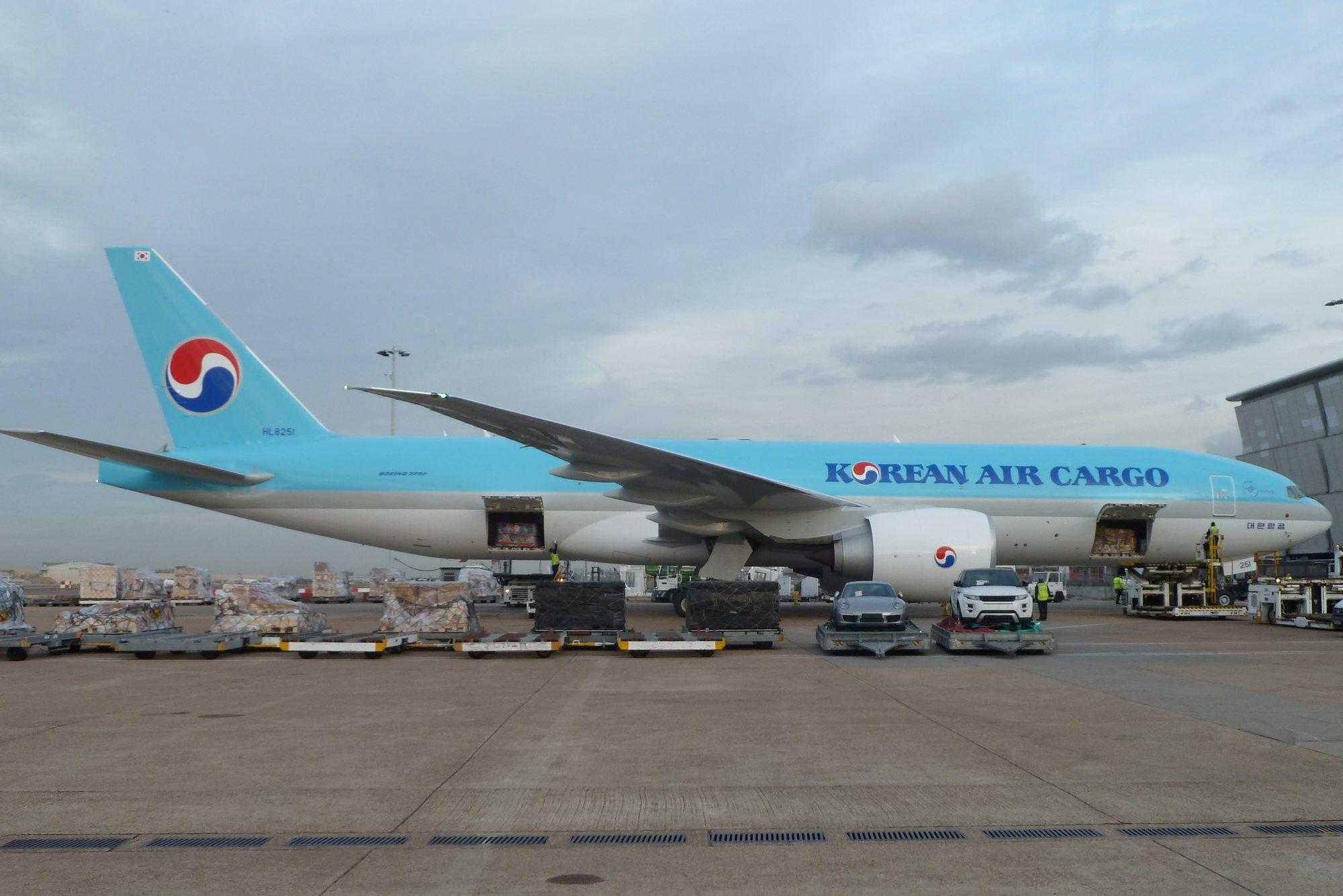
Photo: John Taggart from Sunbury on Thames, Middlesex · CC BY-SA 2.0
On this page
The phone in your pocket, the medicine in a pharmacy fridge and the flowers in a supermarket bucket may all have flown part of their journey, in the hold beneath a passenger cabin or in a windowless freighter that landed overnight. According to the International Air Transport Association (IATA), airlines carry more than 62 million tonnes of goods a year, worth about $8.3 trillion. That is less than 1% of world trade by volume, but more than 33% by value. Here is how that invisible fleet works, and how pandemics, customs rules, war and shipping crises are reshaping it.
Light, Urgent and Valuable#
Flying is the most expensive way to move most goods, so shippers pay for it when speed, security or freshness is worth the premium: electronics, medicines, urgent spare parts, fresh fish, fruit and flowers, and the parcels people order online.
The price gap with the sea is large. In January 2024, pricing firm Xeneta put ocean freight from China to Europe at about $0.52 per kilogram, against $1.61 for a combined sea-air routing through Dubai, FreightWaves reported. Pure air freight costs more again. What shippers buy is time: days instead of weeks.
The industry measures its work in cargo tonne-kilometres (CTK), one tonne carried one kilometre. By that measure 2025 was a record year: IATA reported global demand up 3.4%, led by Asia Pacific airlines (up 8.4%), while North American carriers were the only regional group to shrink (down 1.3%).
Bellies, Freighters and the Space in Between#
Belly cargo rides in the lower deck of passenger jets, next to the luggage. It earns extra revenue on flights that operate anyway and offers shippers a huge web of routes, but it only goes where passengers go.
Dedicated freighters give their main deck over to cargo, so they can take bulky pallets and fly to manufacturing centres at whatever hour suits the cargo. During the pandemic a third, improvised category appeared: "preighters", passenger aircraft flying with cargo only. IATA's data shows how far the balance has swung.
| Year | Passenger belly | Dedicated freighters | Preighters |
|---|---|---|---|
| 2019 | 59% | 41% | none |
| 2020 | 30% | 60% | 10% |
| 2021 | 27% | 60% | 13% |
| 2022 | 42% | 53% | 5% |
| 2023 | 52% | 48% | none |
| 2024 | 55% | 45% | none |
| Q1 2025 | 55% | 45% | none |
Share of global international air cargo capacity (available cargo tonne-kilometres) by aircraft type, rounded. "None" means IATA shows no separate preighter share for that period. Source: IATA, Global Outlook for Air Transport, June 2025, Chart 12.
The mix still matters in a crisis. In April 2026, when Gulf hubs were badly disrupted, IATA noted that dedicated freighters carried much of the month's growth.
The integrators#
The integrators (FedEx, UPS and DHL) sell door-to-door delivery, running their own aircraft, sorting hubs and vans. The academic reference The Geography of Transport Systems notes that the three account for the bulk of global air cargo through hub-and-spoke networks: UPS's main North American hub is Louisville, FedEx's is Memphis, and DHL's main European hub is Leipzig.
On 4 November 2025, UPS Flight 2976, an MD-11 freighter, crashed shortly after take-off from Louisville, killing 15 people: three crew members and 12 people on the ground, Louisville Public Media reported. The FAA grounded all MD-11s. In January 2026 UPS said it was retiring its MD-11s, about 9% of its fleet, the Associated Press reported. The FAA approved Boeing's return-to-service procedure in May 2026 and FedEx resumed MD-11 flights, according to Transport Topics. As of late October 2026, the National Transportation Safety Board investigation is still ongoing.
Lessons From the Pandemic Years#
Covid-19 exposed how much air cargo depends on passenger flying. When passenger fleets were grounded in 2020, their belly capacity vanished too.
Airlines flew empty passenger cabins as cargo planes; in 2021 these preighters supplied 13% of international capacity. Vaccines raised the stakes further: in September 2020, IATA estimated that delivering one dose to 7.8 billion people would fill about 8,000 Boeing 747 freighters, AirlineRatings reported.
The lessons were that belly space is efficient but fragile, and that shocks elsewhere in the supply chain can send freight to the sky in a hurry. In 2024 demand rose 11.3% to a new record, which IATA credited to strong e-commerce and disruption to ocean shipping.
E-Commerce and the End of the Duty-Free Parcel#
The biggest structural change of the past decade is the small parcel shipped straight from a seller in Asia to a shopper's door. In the US, such parcels long entered under the "de minimis" rule, which let goods worth $800 or less in duty-free with minimal paperwork. US Customs and Border Protection (CBP) says these shipments rose from 134 million in 2015 to 1.36 billion in 2024, more than 4 million a day. That door has closed in stages:
- 2 May 2025: de minimis ended for goods from China and Hong Kong (CBP).
- 29 August 2025: suspended for all countries under Executive Order 14324, later continued in February 2026.
- 24 June 2026: CBP regulations indefinitely suspend duty-free treatment for imports of $800 or less.
The trade map moved too. In 2025, IATA's data showed Asia–North America, the largest air cargo lane, slipping 0.8% while Europe–Asia grew 10.3%. IATA described a clear shift in flows towards Asia–Europe, driven by tariff pressures and the removal of the US de minimis exemption.
Europe is tightening too. The European Parliament says 4.6 billion low-value items (under €150) entered the EU in 2024, and 91% of e-commerce shipments under that value came from China. Since 1 July 2026 the EU has applied a temporary €3 customs duty per tariff category, so five T-shirts attract one €3 charge. IATA has warned that tighter customs requirements for low-value shipments may weigh on e-commerce volumes.
When Sea Lanes Close, the Sky Fills Up#
Air cargo is also the shock absorber for ocean shipping. From late 2023, attacks on ships by Yemen's Houthi movement pushed most container lines away from the Red Sea and Suez Canal and around Africa. Between February 2024 and mid-2026, weekly container capacity through Suez averaged just 11% of the same weeks in 2023, Riviera Maritime Media reported.
The detours revived "sea-air" shipping: goods sail to a midway hub such as Dubai, then fly onward. Xeneta data cited by FreightWaves in January 2024 showed the Dubai routing cost just over three times as much as ocean freight but arrived about three weeks sooner.
In 2026 the Gulf hubs themselves were hit. Qatar closed its airspace on 28 February as a US–Israeli military campaign against Iran began, and Iran went on to strike Gulf states, Al Jazeera reported. Qatar Airways, Emirates and Etihad suspended flights, and data from analytics firm Rotate, cited by Air Cargo News, suggested about 12% of global air cargo capacity was directly affected. IATA's figures trace the damage and partial recovery:
| Measure (year-on-year change in CTK) | March 2026 | April 2026 | August 2026 |
|---|---|---|---|
| Europe–Middle East trade lane | −57.6% | −25.9% | −12.1% |
| Middle East–Asia trade lane | −58.6% | −22.4% | −11.0% |
| Middle Eastern airlines, total demand | −54.3% | −18.2% | +1.0% |
| Global air cargo demand | −4.8% | +4.0% | +4.4% |
Sources: IATA releases for March, April and August 2026.
Fuel was the second blow: IATA said jet fuel prices in March 2026 were up 106.6% on a year earlier.
At sea, the picture is improving. As of mid-October 2026, shipping association BIMCO said Red Sea and Suez transits had exceeded 50% of pre-disruption levels for the first time since the Houthi attacks began. Clarksons counted about 753,000 TEU (twenty-foot container units) of weekly Suez capacity in early October, against 1.45 million in the same period of 2023 (Riviera).
In our reading, a lasting return to Suez would ease some of the pressure that pushed urgent freight from ships to planes after 2023, though nobody has measured that effect yet.
India Reaches for a Bigger Share of the Sky#
Indian airports handled about 3.7 million tonnes of cargo in the 2024–25 financial year, up 10%, according to Airports Authority of India data reported by STAT Times. In 2025–26 the total reached 3.96 million tonnes, Civil Aviation Secretary Samir Kumar Sinha said, against a government target of 10 million tonnes a year by 2030 (Forbes India). The concrete is arriving:
- Noida International Airport (Jewar), near Delhi, opened to passengers on 15 June 2026, with its first cargo flight scheduled for 17 June. Its AISATS cargo terminal can initially handle 200,000 tonnes a year and is designed to scale to 1.5 million (ITLN).
- FedEx broke ground on 25 August 2026 on a hub of about $150 million at Delhi's GMR Cargo City, designed to raise its Delhi sorting capacity from 600 to 5,000 packages an hour, on top of a $250 million hub announced for Navi Mumbai (Forbes India; Air Cargo News).
The harder goal is transshipment, meaning cargo that changes planes in India on its way elsewhere. Civil Aviation Minister Ram Mohan Naidu was reported as saying that less than 5% of India's air cargo moves through transshipment, compared with about 75% at Hong Kong. By our own arithmetic, reaching 10 million tonnes would take growth of roughly 20–26% a year, depending on which financial year counts as 2030, several times the 6.5%-plus recorded in 2025–26.
Conclusion: The Fleet Nobody Notices Until It Stops#
Air cargo is a mixed fleet of passenger bellies, freighters and integrators that together carry a sliver of the world's goods by weight and a large share of their value.
The latest figures show a resilient but expensive market. In August 2026, global demand rose 4.4% on a year earlier while capacity slipped 0.1%, and jet fuel cost 79.2% more than a year before (IATA). In its June outlook, IATA forecast that 2026 volumes would grow just 0.2% to 71.7 million tonnes, while cargo revenue would rise 7.2% to $162 billion, mostly because airlines are passing on higher fuel costs (IATA).
The next time a parcel arrives sooner than seemed possible, remember the aircraft, hubs and customs rules behind it, most of which you will never see.