Your First Night Under the Stars: A Beginner's Guide to Stargazing
No telescope required: how to train your eyes, escape light pollution and find the Moon, planets, Orion, the Pleiades and Andromeda.

On this page
You do not need expensive equipment, a science degree or a remote mountaintop to start exploring the night sky. You need a clear night, a little patience and a few pieces of know-how that most people are never taught. The sky that guided ancient navigators is still free to anyone who looks up. This guide covers what you need for your first nights out, from training your eyes to finding a galaxy millions of light-years away.
Let Your Eyes Go Dark#
Your eyes are your most important instrument, and they need time to adjust. When you step out of a lit room, your pupils widen fairly quickly, but the bigger change is chemical. The rod cells in your retina, which handle low-light vision, slowly rebuild a light-sensitive pigment called rhodopsin. Most of that recovery happens over 20 to 30 minutes, and sensitivity keeps creeping up for a while after.
A single glance at a bright phone screen can undo much of that progress. A few habits help:
- Use red light. Rod cells are much less sensitive to deep red light, so a dim red flashlight (or a regular one covered with red cellophane) lets you read a chart without wrecking your night vision.
- Tame your phone. Turn the brightness all the way down and use a red night mode if your app has one.
- Try averted vision. Rods are concentrated away from the center of your gaze. Look slightly to one side of a faint object and it often appears brighter.
The darkness is not an obstacle to stargazing. Given half an hour, it becomes your most powerful tool.
Escape the Glow#
Light pollution is the biggest enemy of the night sky. Streetlights and floodlights scatter light into the atmosphere, washing out all but the brightest stars. A world atlas of artificial sky brightness published in 2016 estimated that more than a third of humanity can no longer see the Milky Way from home, and a 2023 study of citizen-science observations suggested skies had been brightening by nearly 10% a year.
Amateur astronomers often rate sky quality with the Bortle scale, a nine-step scale published by John Bortle in 2001. Roughly speaking:
- Classes 1–2: truly dark, remote sites, where the Milky Way shows rich structure.
- Classes 3–4: rural skies, where the Milky Way is still striking overhead.
- Classes 5–6: suburbs, where the Milky Way is faint or visible only high overhead.
- Classes 7–9: cities, where only the Moon, the planets and a scattering of bright stars remain.
Online light-pollution maps can point you to darker skies nearby, and DarkSky International certifies parks and reserves that protect them. Even a short drive out of town can make a dramatic difference. Check the Moon's phase too: a full Moon washes out faint objects as surely as a streetlight.
Binoculars Before Telescopes#
It is tempting to buy a telescope right away, but a decent pair of binoculars is often the smarter first purchase. They are affordable, portable, quick to aim, and show a wide patch of sky, which makes finding things far easier.
Look for 7×50 or 10×50 binoculars. The first number is the magnification; the second is the width of each front lens in millimeters, and bigger lenses gather more light. Brace your elbows on a fence or lie back in a reclining chair to keep the view steady.
When you are ready for a telescope, remember that aperture (the width of the main lens or mirror) matters far more than magnification, so be wary of boxes boasting huge magnifications. Many beginners do well with a simple Dobsonian reflector, and a local astronomy club is a great place to try telescopes before buying.
Maps for the Sky#
You do not have to memorize the constellations first. Apps such as Stellarium (free and open source), SkySafari, Star Walk and Sky Tonight let you point your phone at the sky and see what is there. A planisphere, a rotating star wheel made for your latitude, does the same job without batteries, and many astronomy magazines publish free monthly sky charts. As you learn a few bright stars, try "star hopping": using familiar patterns as signposts to reach fainter targets.
What to Look for First#
Start with the bright, easy showpieces. The planets and the Moon move, so check an app before heading out.
The Moon and the planets#
The Moon is the perfect first target, but full Moon is the worst time to view it. Look instead along the terminator, the line between day and night, where long shadows make craters leap out, even in binoculars. Venus is the dazzling "evening star" or "morning star" near the horizon. Binoculars can show up to four of Jupiter's largest moons as tiny points of light, while Saturn's rings need a small telescope. A handy rule of thumb: planets usually twinkle less than stars.
Orion and the Pleiades#
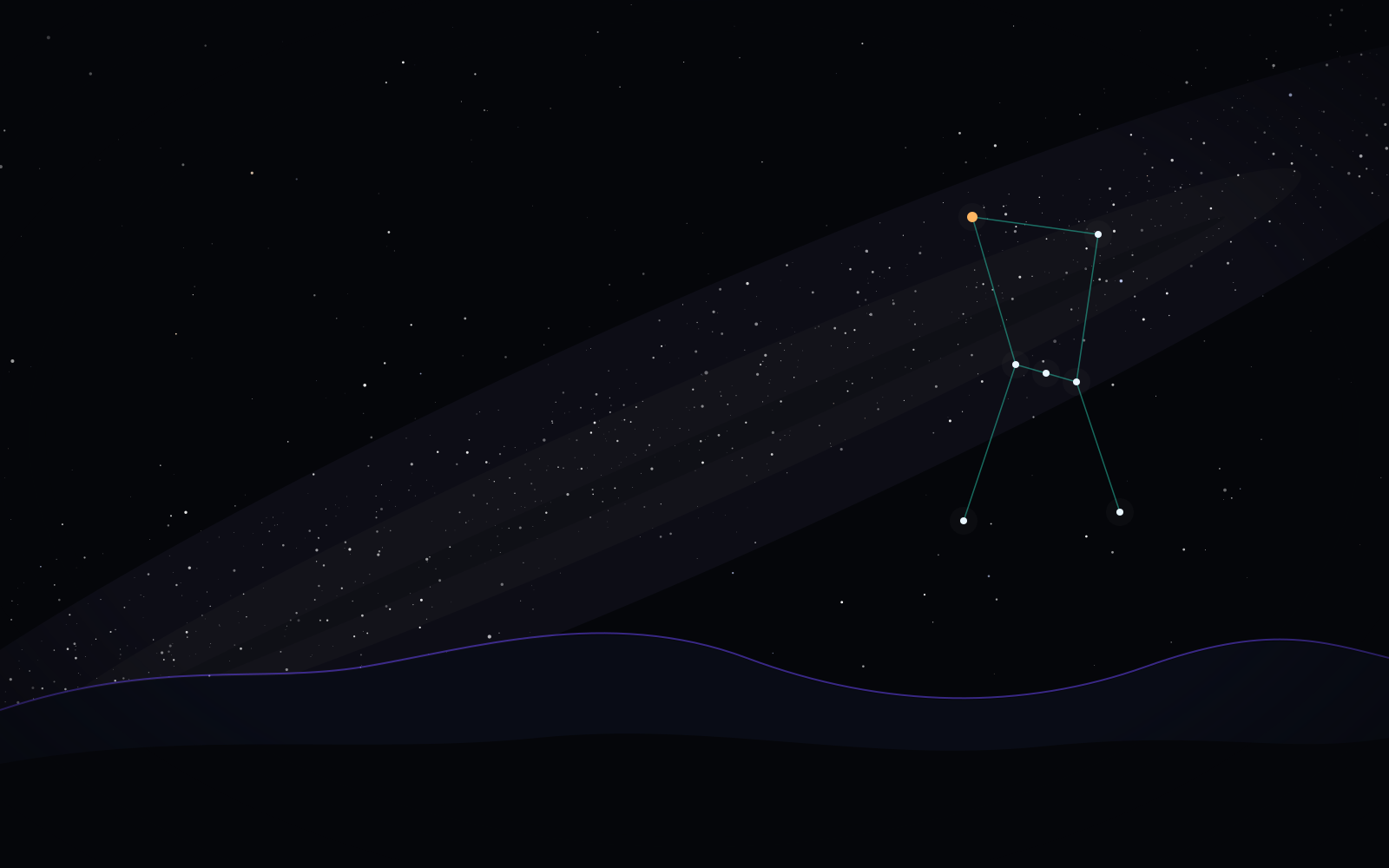
Orion dominates evening skies from roughly December to March and, because it straddles the celestial equator, is visible from almost everywhere people live (upside down from the Southern Hemisphere). Look for orange-red Betelgeuse, blue-white Rigel and the three stars of the belt. Below the belt hangs the sword, where a fuzzy patch is the Orion Nebula, a stellar nursery roughly 1,300–1,400 light-years away. Follow the belt upward past orange Aldebaran to reach the Pleiades, a tiny dipper-shaped cluster. Most people see six or seven stars; binoculars reveal dozens. Its distance, about 440 light-years, was the subject of a long-running dispute between measurement techniques that newer data has largely settled.
The Andromeda Galaxy#
On autumn evenings in the Northern Hemisphere, look for a faint oval smudge near the Great Square of Pegasus. That is the Andromeda Galaxy, about 2.5 million light-years away and usually cited as the most distant thing most people can see with the naked eye. Its light left long before our species existed. Southern observers have their own treasures, including the Southern Cross and the Magellanic Clouds, two small galaxies that orbit the Milky Way.
Meteor showers#
Meteor showers happen when Earth passes through debris left by comets or, in at least one case, an asteroid. Reliable ones include the Quadrantids in early January, the Perseids in mid-August, the Orionids in late October and the Geminids in mid-December. Lie back, take in as much sky as you can, and give it at least an hour. Rates are usually best after midnight, and published peak rates assume perfect skies, so expect fewer.
Your Stargazing Checklist#
Before you head out, run through this list:
- A clear forecast and a check of the Moon's phase
- Warm layers, a hat and gloves (nights get colder than you expect)
- A red flashlight
- A sky app in night mode, a planisphere or a printed chart
- Binoculars, if you have them
- A reclining chair or blanket, plus a hot drink
- Patience: give your eyes at least 20 minutes
Then switch off the lights, look up and let the sky come to you.