How Black Holes Bend Light
Gravity can bend starlight into arcs, rings and shadows. Here is how black holes warp light, and how astronomers finally photographed one.

On this page
Light is the fastest thing in the universe, and for most of history it seemed to travel in perfectly straight lines. Then, a little over a century ago, Albert Einstein's new theory of gravity made a bold claim: mass bends the path of light. Near an ordinary star the effect is tiny. Near a black hole it becomes extreme. Light curves, loops, piles up into glowing rings and, past a certain point, never comes back at all. Following that light is one of the best ways to understand these strange objects, and how we finally managed to see one.
Gravity as Curved Spacetime#
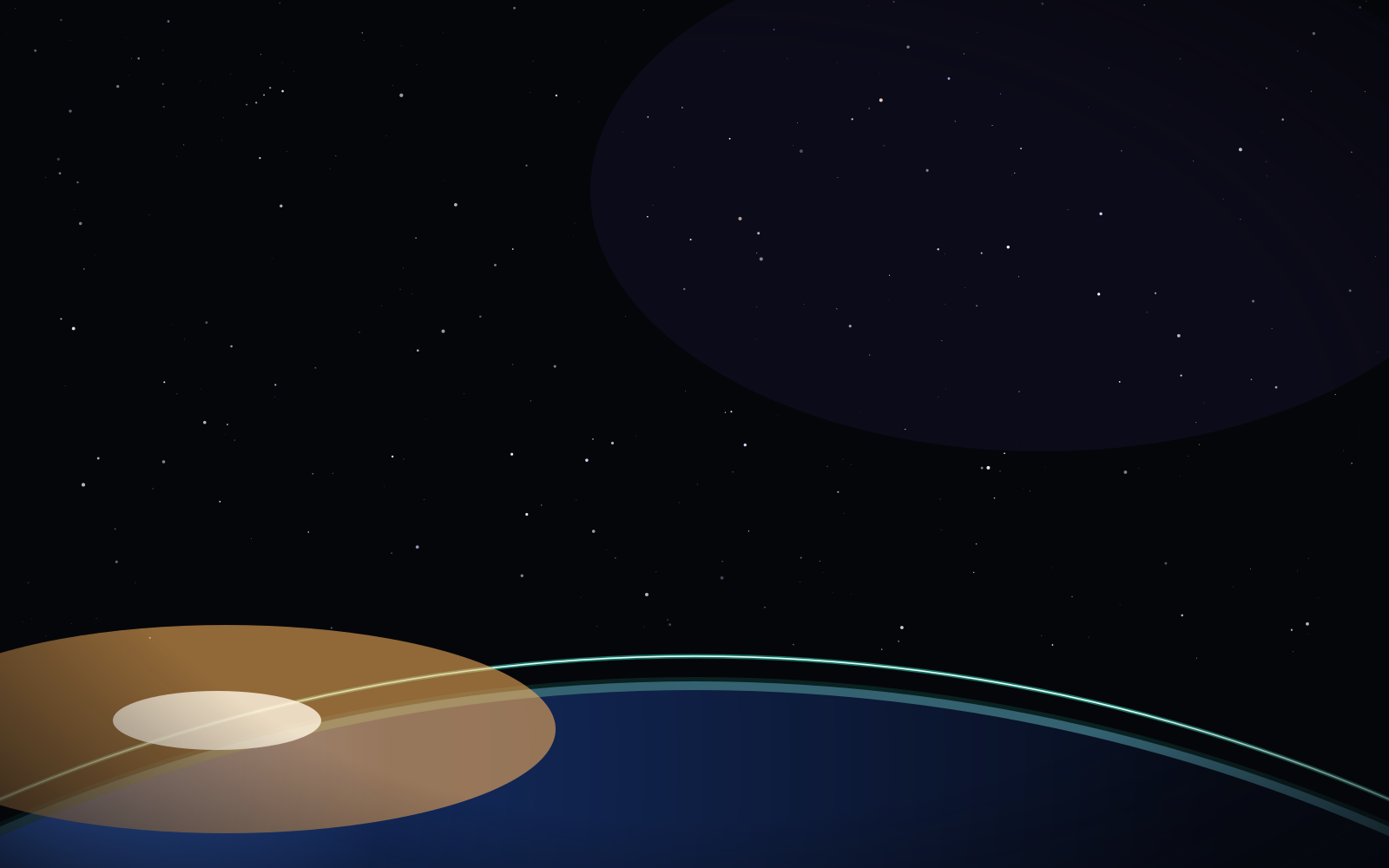
In Isaac Newton's picture, gravity is a force that pulls masses toward one another. Einstein's general theory of relativity, completed in 1915, recast it as geometry. Mass and energy curve spacetime, and anything moving through it, including massless light, follows the straightest possible path through that curved landscape.
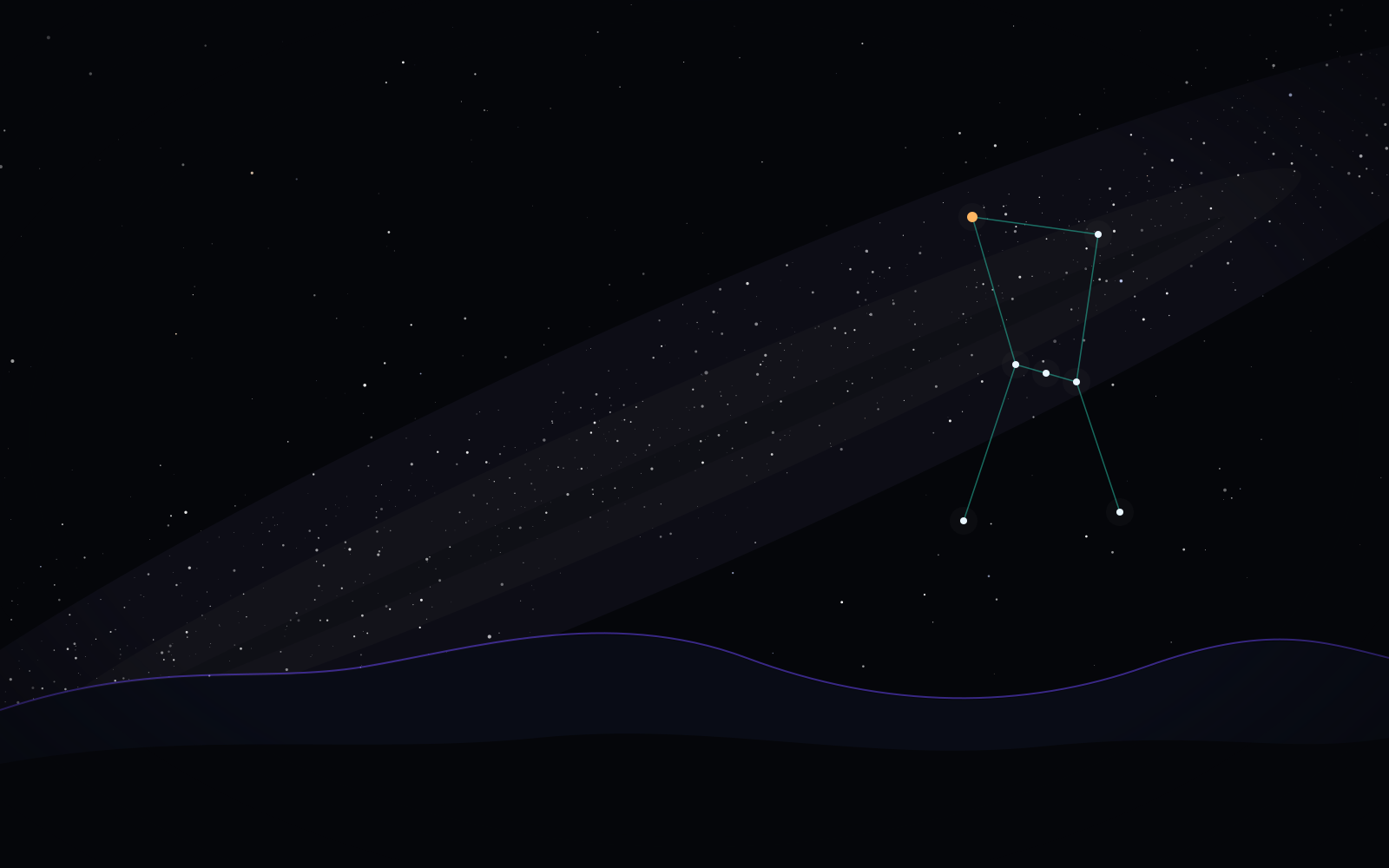
The theory made a precise, testable prediction. Starlight grazing the edge of the Sun should be deflected by about 1.75 arcseconds, twice what a Newtonian calculation gives. In 1919, expeditions organized by Frank Dyson and Arthur Eddington photographed stars near the Sun during a total solar eclipse, from the island of Príncipe off West Africa and from Sobral in Brazil. Their measurements were rough, and historians still debate how decisive they were, but they favored Einstein, and far more precise radio measurements have since confirmed the prediction.
Gravity does not so much pull light off course as reshape the road it travels on. The more mass, and the closer the light passes, the sharper the bend.
Cosmic Lenses: Arcs, Rings and Flickers#
Any mass bends light, so galaxies, galaxy clusters and even single stars can act as lenses, magnifying and distorting whatever lies behind them. Astronomers call this gravitational lensing, and it comes in several varieties:
- Strong lensing: a massive galaxy or cluster bends light so much that a background object appears as multiple images or stretched arcs. The first confirmed case, the "Twin Quasar" identified in 1979, showed one distant quasar as two.
- Weak lensing: subtle distortions in the shapes of huge numbers of galaxies, used to map invisible dark matter.
- Microlensing: a star or planet drifting in front of a more distant star briefly brightens it. The technique has found exoplanets and, in 2022, what is widely interpreted as the first lone stellar-mass black hole wandering through our galaxy, though teams initially disagreed about its mass.
Einstein rings#
When a background source, a lensing galaxy and the observer line up almost perfectly, the image smears into a complete circle: an Einstein ring. In 2025 the European Space Agency's Euclid telescope revealed a strikingly complete ring around the galaxy NGC 6505, roughly 600 million light-years away, formed by light from a galaxy billions of light-years farther off. A ring's size reveals how much mass is doing the bending, so astronomers can weigh the lensing galaxy, dark matter and all.
Falling Toward the Event Horizon#
A black hole is a region where so much mass is packed into so small a space that, inside a boundary called the event horizon, nothing can escape, not even light. For a black hole with the mass of our Sun, the event horizon would be only about 6 kilometers across. Scale the mass up and the horizon grows in proportion. Close to that boundary, light starts to behave very strangely.
The photon sphere#
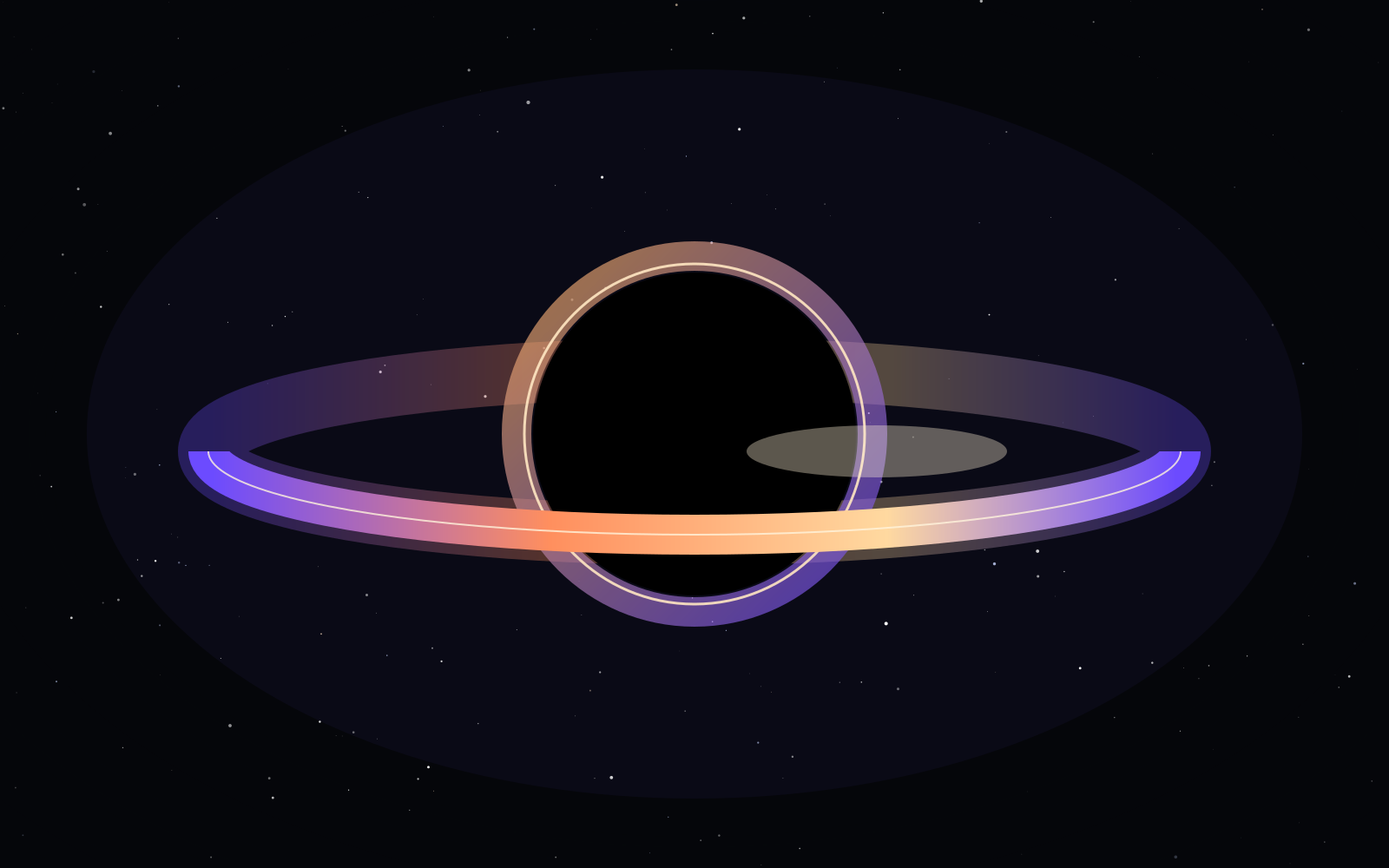
At one and a half times the radius of the event horizon (for a non-spinning black hole) lies the photon sphere, where gravity is strong enough for light to travel in a circle. Those orbits are unstable, but light passing just outside this zone can be wrapped partway, fully, or even several times around the black hole before escaping. The consequences are startling:
- You can see the far side of a disk of glowing gas, lensed up and over the top of the black hole.
- A star directly behind a black hole can appear as a ring or as a series of nested images.
- The black hole casts a dark "shadow" roughly two and a half times wider than its event horizon, because light rays that come too close are swallowed rather than escaping toward us.
In 1979 the French astrophysicist Jean-Pierre Luminet produced the first simulated image of a black hole and its glowing disk, drawing the final picture by hand from computer calculations. For decades, such images were only predictions.
Photographing a Shadow#
Seeing a black hole's shadow demands astonishing sharpness. Even the biggest-looking black holes in our sky appear about as large as a doughnut on the Moon would look from Earth. To resolve them, the Event Horizon Telescope (EHT) collaboration linked radio observatories from Hawaii and Chile to Spain and the South Pole into a virtual telescope roughly the size of our planet, observing at a wavelength of 1.3 millimeters.
| Feature | M87* | Sagittarius A* |
|---|---|---|
| Image released | April 2019 | May 2022 |
| Distance from Earth | About 55 million light-years | About 27,000 light-years |
| Mass | About 6.5 billion Suns | About 4 million Suns |
| Apparent ring size | About 42 microarcseconds | About 52 microarcseconds |
M87*#
The first image of a black hole, released on 10 April 2019, showed M87*, at the heart of the giant galaxy Messier 87. Its event horizon would swallow our solar system out past the orbit of Pluto. The image revealed a lopsided ring of glowing gas around a dark center, brighter on one side because material moving toward us at close to light speed has its light boosted. Later observations found the ring persisting at the same size, as expected if gravity, not passing turbulence, sets its shape.
Sagittarius A*#
In May 2022 came Sagittarius A*, the black hole at the center of our own Milky Way. It is more than a thousand times less massive than M87* but so much closer that its ring looks slightly larger on our sky. Imaging it was harder: gas around Sgr A* circles in minutes rather than days, so the target kept changing during each night of observation. Yet the two images look remarkably alike, a strong hint that general relativity describes black holes of very different sizes in the same way.
What the Bending Tells Us#
Light bending began as a tiny shift in star positions during an eclipse. Today it magnifies distant galaxies for telescopes like JWST, maps unseen dark matter and, around black holes, turns gravity itself into something we can photograph.
Open questions remain. The EHT images are reconstructions built from sparse data, and a few independent reanalyses have questioned some details, though the collaboration and others have defended the results. Future observations, possibly including radio dishes in space, aim to pick out finer structure such as the thin "photon ring" predicted to lie within the bright ring. Each sharper picture is another test of Einstein's theory, and so far it keeps passing.