Webb's Time Machine: How the James Webb Space Telescope Sees the Dawn of Galaxies
How a gold-mirrored telescope 1.5 million km from Earth uses infrared light to see galaxies from the universe's first few hundred million years.

On this page
Every time you look at the night sky, you are looking into the past. Moonlight is a little over a second old when it reaches your eyes. The faint glow of the Andromeda Galaxy left it about 2.5 million years ago. Look far enough and you reach light that set out when the universe itself was young, long before the Sun or Earth existed. The James Webb Space Telescope was built to catch that ancient light, and in only a few years of science it has rewritten parts of the story of how the first galaxies formed.
A Telescope Built to Unfold#
Webb is a joint project of NASA, the European Space Agency and the Canadian Space Agency. It launched on 25 December 2021 aboard an Ariane 5 rocket from Kourou in French Guiana, after decades of development, repeated delays and a price tag of roughly $10 billion.
The telescope was far too large to fit inside a rocket fully assembled, so it flew folded up like origami. Over the following two weeks it unfolded itself in space, a sequence so intricate that NASA counted roughly 344 single-point failures, any one of which could have crippled the mission. None did. After months of alignment and calibration, Webb began science operations in July 2022.
The golden mirror#
Webb's most recognizable feature is its primary mirror:
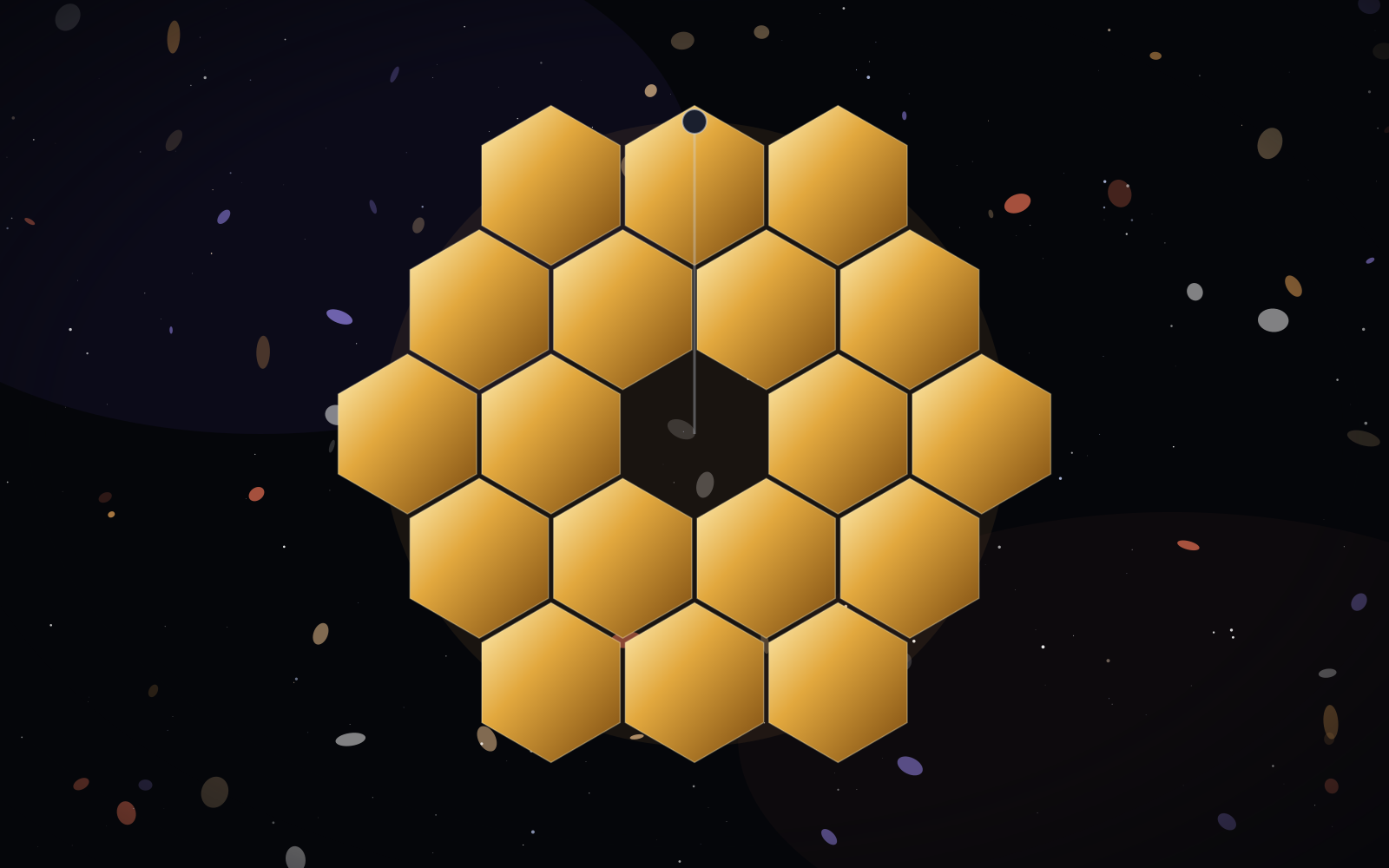
- It is 6.5 meters across, built from 18 hexagonal segments that each measure about 1.3 meters.
- The segments are made of beryllium, a light, stiff metal that holds its shape at very low temperatures.
- Each is coated with a microscopically thin layer of gold, which reflects infrared light extremely well. The total amount of gold is only about 48 grams, roughly the mass of a golf ball.
Together the segments act as one smooth surface with about six times the light-collecting area of the Hubble Space Telescope.
Parked 1.5 Million Kilometers Away#
Hubble orbits only a few hundred kilometers above Earth. Webb lives near a point called Sun–Earth L2, about 1.5 million kilometers from Earth on the side facing away from the Sun, roughly four times the distance to the Moon. It does not sit exactly at L2 but traces a large "halo" orbit around it, taking about six months per loop.
The location matters because the Sun, Earth and Moon all stay on roughly the same side of the telescope, so a single sunshield can block all three. The shield has five layers of a thin, metal-coated plastic film called Kapton, some about as thin as a human hair, spread over an area about the size of a tennis court. Between its sun-facing side and its cold side, the temperature differs by roughly 300 degrees Celsius. The instruments sit in the shade at around −230 °C, and the mid-infrared instrument is chilled further by a cryocooler, to below 7 kelvin.
Why go to such lengths? A warm telescope glows in infrared light, and that glow would drown out the faint signals Webb is trying to catch.
Why Infrared Is the Key#
The universe is expanding, and as light travels across expanding space its waves get stretched to longer, redder wavelengths. Astronomers call this redshift and measure it with a number, z: light from an object at redshift z has had its wavelength stretched by a factor of 1 + z. For a galaxy at redshift 10, ultraviolet light emitted at about 0.12 microns arrives at about 1.3 microns, well into the infrared.
Hubble sees mainly visible and ultraviolet light, with some near-infrared. Webb is designed for infrared, covering roughly 0.6 to 28 microns, which makes it the right tool for several jobs:
- Catching light from very distant galaxies that has been redshifted out of the visible range.
- Peering through clouds of dust to see stars and planets forming inside them.
- Detecting the faint warmth of cool objects such as brown dwarfs and planets.
- Reading the chemical fingerprints that molecules leave in starlight.
Webb is not simply a bigger Hubble. It is a time machine tuned to the color that ancient light becomes after billions of years of cosmic stretching.
Galaxies From the Cosmic Dawn#
The universe is about 13.8 billion years old. Before Webb, the most distant galaxy with a confirmed redshift was GN-z11, seen by Hubble as it was roughly 400 million years after the Big Bang. Webb pushed that frontier back quickly. In 2024 a team confirmed JADES-GS-z14-0, seen roughly 300 million years after the Big Bang. In 2025 an even more distant galaxy, MoM-z14, was reported at a redshift of about 14.4, around 280 million years after the Big Bang. Records like these are falling fast, so treat them as a snapshot rather than a final answer.
The bigger story is what Webb found at those distances:
- More bright galaxies, earlier, than many models predicted. The early universe seems to have formed stars faster or more efficiently than expected, although the reasons are still debated.
- Fewer "impossible" galaxies than first claimed. Early reports of galaxies too massive to exist so soon were partly walked back as better data arrived. In some cases, part of the light seems to come from growing black holes rather than stars.
- Mysterious "little red dots." These compact, red objects, common in the first billion or so years, may be dust-shrouded growing black holes or something more unusual. There is no consensus yet.
None of this overturns the Big Bang. It challenges our models of how galaxies assembled, not the idea that the universe began hot and dense and has been expanding ever since.
Reading the Air of Alien Worlds#
Webb also studies planets orbiting other stars. When a planet passes in front of its star, a sliver of starlight filters through the planet's atmosphere. Molecules there absorb particular wavelengths, leaving a fingerprint Webb can read.
- WASP-96 b: Webb's first image release in July 2022 included a clear signature of water vapor in this hot gas giant's atmosphere.
- WASP-39 b: Webb made the first clear detection of carbon dioxide in an exoplanet's atmosphere, plus sulfur dioxide produced by starlight-driven chemistry.
- TRAPPIST-1 b and c: heat measurements suggest these rocky worlds lack thick, carbon-dioxide-rich atmospheres like Venus's, although thinner atmospheres have not been ruled out.
- K2-18 b: Webb detected methane and carbon dioxide. Claims of dimethyl sulfide, a gas produced on Earth mainly by marine life, drew headlines, but other researchers have found the evidence weak. It is best treated as unconfirmed.
A Long Mission Ahead#
Webb's launch was so precise that it saved a great deal of propellant, and NASA expects the telescope to keep working for well over a decade, possibly around twenty years.
The deepest lesson from its first years is that the young universe was busier, brighter and quicker to build galaxies than many astronomers expected. Each answer has opened new questions, and the telescope is only getting started.