The Environmental Cost of Flying, and the Race to Fix It
Aviation's climate impact, the contrail puzzle, and whether sustainable fuels, efficiency, electric and hydrogen aircraft can reach net zero by 2050.

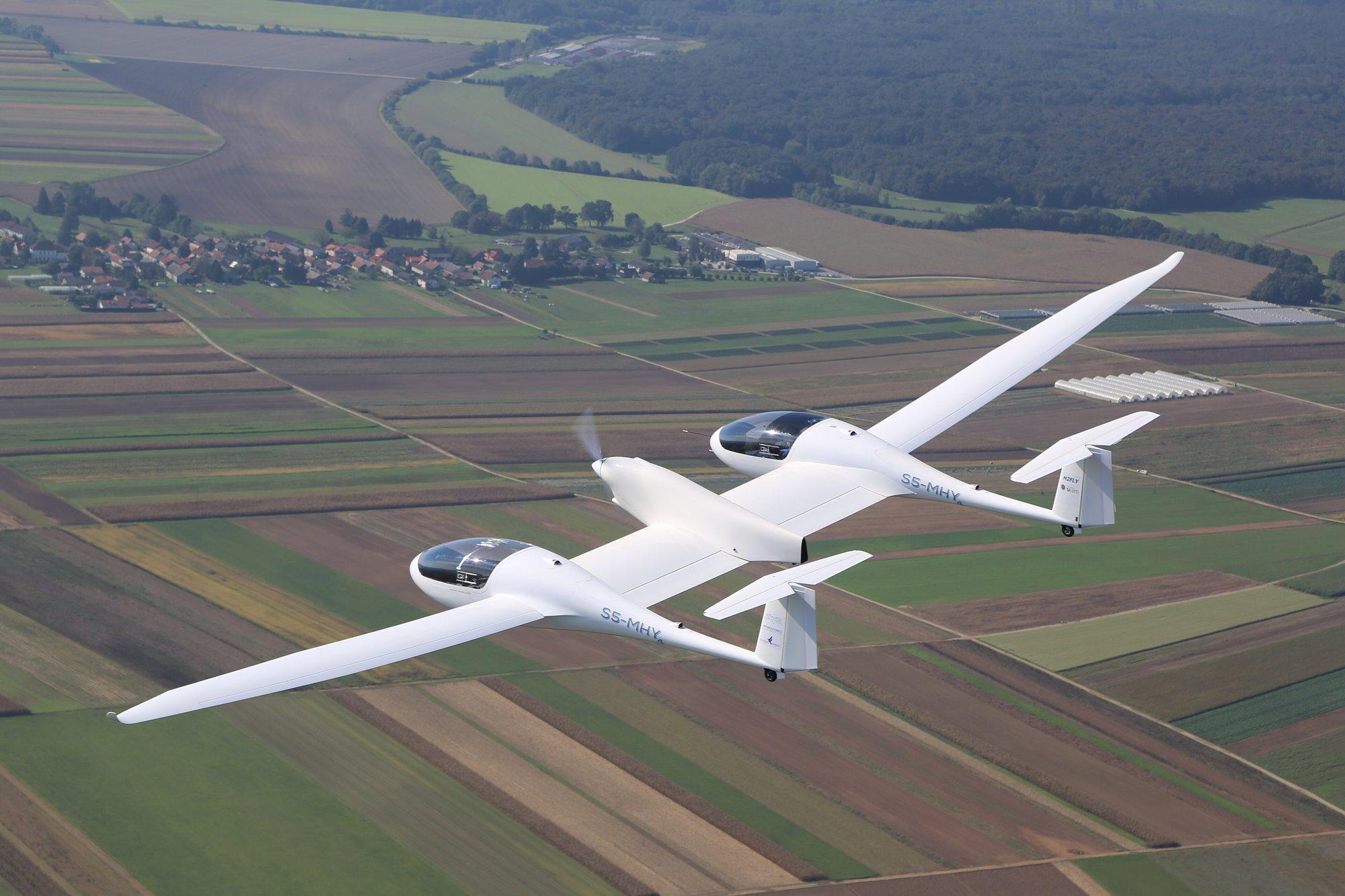
Photo: Jean-Marie Urlacher · CC BY-SA 4.0
On this page
Flying is hard to decarbonise. Aircraft need fuel that packs a lot of energy into little weight, they stay in service for decades, and demand keeps growing. Even so, airlines and governments have signed up to net-zero carbon dioxide (CO2) emissions by 2050. This analysis looks at how large aviation's climate impact really is, including the uncertain role of contrails, and at the tools on offer: sustainable aviation fuel (SAF), more efficient aircraft, and electric and hydrogen propulsion. It separates what is already happening from what is only forecast, and attributes every forecast to whoever made it.
How Big Is Aviation's Climate Footprint?#
Aviation produced about 2.5% of global CO2 emissions from fossil fuels and land use in 2019, according to Our World in Data. That share fluctuated between 2% and 2.5% from the mid-1990s and has risen since 2010. Aircraft have become more efficient, but passenger and freight demand roughly quadrupled between 1990 and 2019, so total emissions kept climbing.
A major scientific assessment by David Lee and 20 co-authors, published in Atmospheric Environment, found that aviation's CO2 emissions grew by a factor of 6.8 between 1960 and 2018, reaching 1,034 million tonnes a year. Measured by effective radiative forcing, the change in the planet's energy balance that drives warming, the study calculated aviation's contribution at about 3.5% of the human total for 2011.
The picture is similar in Europe. The European Commission says aviation accounted for roughly 3.8% to 4% of the EU's greenhouse gas emissions in 2022 and 13.9% of its transport emissions.
Contrails and the Non-CO2 Question#
That two-thirds figure is what makes aviation unusual. Besides CO2, aircraft emit nitrogen oxides, water vapour and particles, and at cruising altitude they can create condensation trails that spread into cirrus-like clouds. The Lee study found that this "contrail cirrus" is the largest single warming term, at an estimated 57.4 milliwatts per square metre in 2018, but with a wide 5–95% range of 17 to 98.
Europe has started measuring the problem. Monitoring of non-CO2 effects under the EU's rules began on 1 January 2025, and reporting becomes mandatory for all flights into and out of the European Economic Area from January 2027, according to the Commission.
Some contrails may be avoidable by adjusting flight paths. In a 2023 trial with American Airlines and Breakthrough Energy, Google reported that pilots on 70 test flights using AI predictions produced 54% fewer contrails, measured by satellite. The flights that tried to avoid contrails burned 2% more fuel; Google estimated the fleet-wide fuel penalty could be as low as 0.3% because only a small share of flights would need adjusting. That is a promising result from one trial, not a proven global solution, and the extra fuel burned adds CO2 that must be weighed against the contrails avoided.
The Global Rulebook: ICAO's Net-Zero Goal and CORSIA#
International flights are governed collectively through the International Civil Aviation Organization (ICAO). Its 41st Assembly, held in October 2022, adopted a long-term global aspirational goal of net-zero carbon emissions from international aviation by 2050. ICAO is explicit that the goal does not assign specific obligations or commitments to individual states.
Alongside it sits CORSIA, which ICAO describes as the first global market-based scheme to apply to a whole sector. Airlines offset growth in international CO2 emissions above a baseline, which for 2024–2035 is set at 85% of 2019 emissions. According to ICAO's CORSIA FAQs, participation was voluntary in the pilot phase (2021–2023) and first phase (2024–2026). The second phase, from 2027 to 2035, applies to all member states, with exemptions for small aviation markets, least developed countries, small island developing states and landlocked developing countries.
ICAO itself presents CORSIA as complementary to cutting emissions within the sector through technology, operations and cleaner fuels. Offsets do not reduce what comes out of the engines. In November 2023 a conference in Dubai adopted an ICAO global framework for aviation cleaner energies, which IATA summarises as aiming to make international aviation's fuel 5% less carbon-intensive by 2030.
Sustainable Aviation Fuel: Mandates Outrun Supply#
SAF is jet fuel made from non-fossil sources such as used cooking oil, waste and residues, or renewable electricity combined with captured carbon. It can be blended with conventional kerosene and used in today's aircraft. Most current production uses waste and residue oils through a process known as HEFA, which typically cuts lifecycle emissions by around 80% compared with fossil jet fuel, according to IATA's SAF fact sheet. The catch is volume and price: IATA says SAF is less than 1% of global aviation fuel use and several times more expensive than conventional fuel.
| Year | SAF production (IATA estimate) | Share of global jet fuel |
|---|---|---|
| 2022 | 0.25 million tonnes | Not stated |
| 2023 | 0.5 million tonnes | About 0.2% |
| 2024 | About 1.0 million tonnes | About 0.3% |
| 2025 (estimate) | About 1.9 million tonnes | About 0.6% |
| 2026 (projection) | About 2.4 million tonnes | About 0.8% |
Governments are trying to force the pace. The EU's ReFuelEU Aviation regulation requires fuel supplied at EU airports to contain rising minimum shares of SAF, including a sub-target for synthetic fuels made from renewable electricity (European Commission; IATA handbook):
| From | Minimum SAF share | Of which synthetic fuel |
|---|---|---|
| 2025 | 2% | — |
| 2030 | 6% | 1.2% average over 2030–2031 |
| 2035 | 20% | 5% |
| 2040 | 34% | 10% |
| 2045 | 42% | 15% |
| 2050 | 70% | 35% |
The UK's SAF mandate also began in 2025. According to an IATA briefing in June 2026, roughly 1 million tonnes of SAF was expected to be supplied in 2025 to meet the EU and UK mandates. The same briefing said global SAF production capacity is expected to exceed 9 million tonnes in 2026, yet only about 2.4 million tonnes will actually be produced, because producers often favour more profitable renewable diesel.
The debate is sharp. IATA, which represents airlines, argues that the European and UK mandates have failed to accelerate production and have doubled what airlines pay for SAF compared with market prices. The EU, for its part, uses its emissions trading system to help cover the price gap for airlines buying eligible fuels on covered flights, according to the Commission.
Efficiency, Electric and Hydrogen Aircraft#
Efficiency: the quiet workhorse#
Each new generation of aircraft brings steady gains. Airbus says its A320neo burns at least 20% less fuel and emits 20% less CO2 per seat than the previous generation (Airbus), and it has outlined a next-generation single-aisle aircraft that could enter service in the second half of the 2030s. But, as the demand figures above show, efficiency gains alone have not stopped total emissions from rising.
Electric and hydrogen-electric aircraft#
Batteries are heavy, so electric flight is starting small. In August 2026 Heart Aerospace flew its X1 demonstrator, which has a 106-foot wingspan and weighs more than 25,000 pounds, for 27 minutes on battery power alone; the company calls it the largest battery-electric aircraft ever flown. Its planned production aircraft, the ES-36, is a 36-seat hybrid: Heart quotes an all-electric range of 200 km and 1,200 km using onboard turbogenerators.
Hydrogen-electric start-up ZeroAvia passed a regulatory milestone in April 2026, when the FAA published special conditions for the 600 kW electric propulsion system at the heart of its planned powertrain for 10–20-seat aircraft. ZeroAvia calls this a major step towards type certification, but has not published a certification date.
Airbus ZEROe#
The most closely watched hydrogen programme belongs to Airbus. In 2020 it unveiled three hydrogen concepts that it said could enter service by 2035. In March 2025 it said it had adjusted its roadmap and selected a fully electric design, with four 2-megawatt motors each powered by a hydrogen fuel cell system fed from two liquid-hydrogen tanks, with integrated ground testing planned for 2027.
What Is Realistic by 2030 and 2050?#
For 2030, the firmest markers are legal and political rather than technological: the EU's 6% SAF requirement, the ICAO framework's 5% carbon-intensity aim, and the start of CORSIA's broader second phase in 2027. A rough calculation from IATA's own figures shows the scale of the gap. If 2.4 million tonnes is 0.8% of global jet fuel, total demand is around 300 million tonnes a year; even 20 million tonnes of SAF capacity, fully used, would cover only about 7% of today's demand.
In The Kármán Line's reading of the evidence, battery and hydrogen-electric aircraft are likely to matter first on short regional routes, while long-haul flights will depend on SAF for decades. Hydrogen airliners of meaningful size remain a post-2035 prospect at best, and the non-CO2 question could change the calculus in either direction once Europe's monitoring data arrive.
Conclusion: A Race Against the Clock#
Aviation's climate problem is real, growing, and only partly understood, because the warming from contrails is still uncertain. The fixes are no longer theoretical: SAF is flowing, a full-size electric demonstrator has flown, and binding fuel mandates are in force. But the numbers remain small next to the size of the industry. On IATA's pathway, reaching net zero by 2050 means scaling SAF more than 200-fold from 2026 levels, turning prototypes into certified aircraft, and deciding how to account for non-CO2 effects. None of those is guaranteed, and the timelines set by companies and governments are targets, not facts.