How Indian Airlines Are Competing for the Future
IndiGo and the Air India group now carry over 92% of India's domestic flyers. How they, Akasa and the rest compete in a market that lives on low fares.

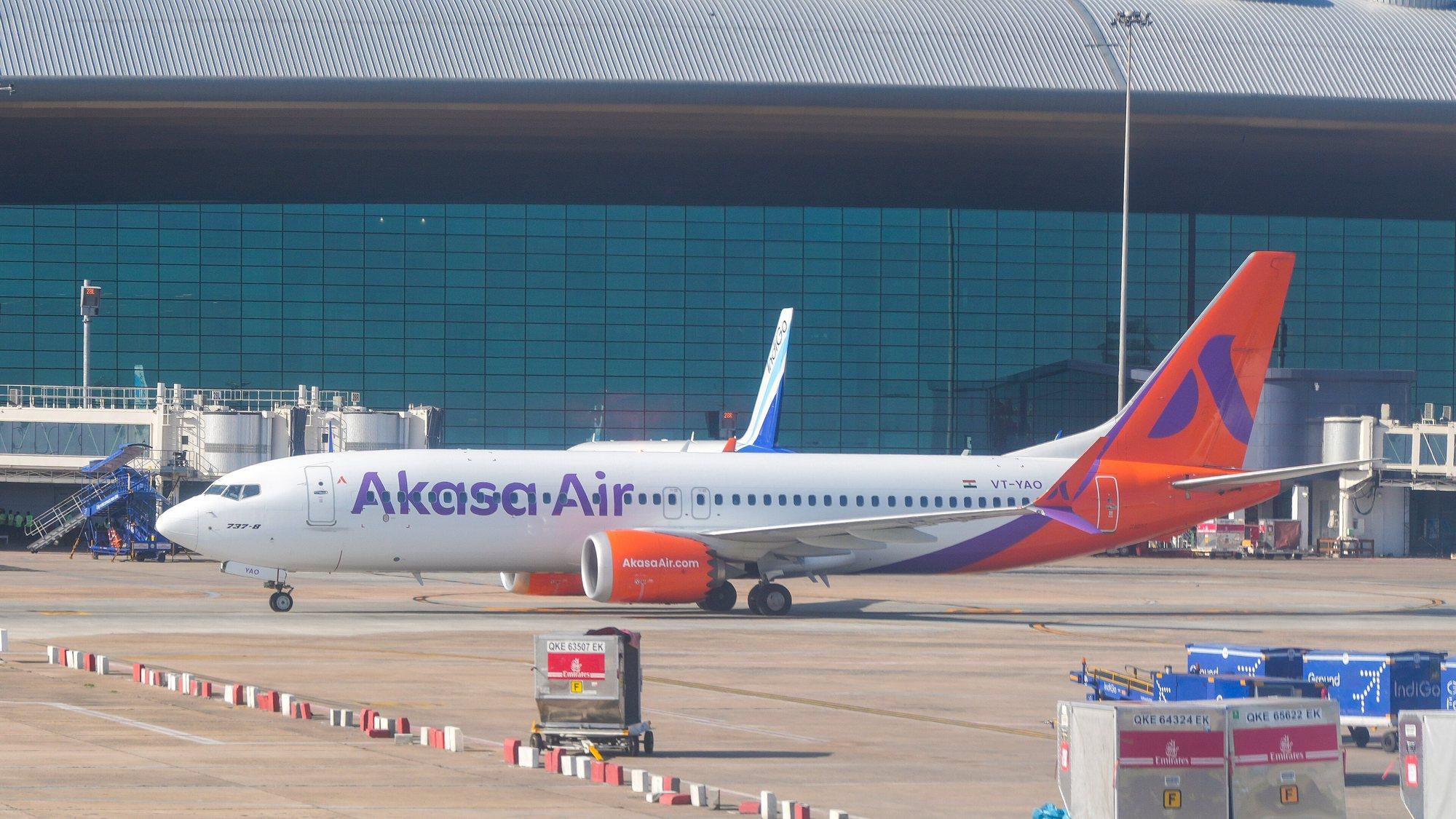
Photo: Timothy A. Gonsalves · CC BY-SA 4.0
On this page
Making money by flying passengers in India has always been hard. Passengers shop on price, fuel is expensive and heavily taxed, and much of an airline's cost base is priced in US dollars while its revenue arrives in rupees. Even so, carriers keep ordering hundreds of new aircraft and betting on decades of growth. In late 2026, the competition has narrowed to two dominant groups, a fast-growing newcomer and a handful of struggling or regional airlines. This analysis looks at how each is positioning itself, and what India's airline failures suggest about who will last.
A Market That Runs on Low Fares#
Most Indian domestic flying follows the low-cost model. Airlines use one or two aircraft families to simplify maintenance and training, keep planes in the air for as many hours a day as possible, and sell extras such as seat selection and meals separately. The aim is the lowest possible cost per seat, because the Indian traveller's first question is usually the fare.
That price sensitivity is visible in 2026. With fares rising, travellers have been booking later, skipping optional trips and, on some short routes, switching to trains. Meanwhile, the airlines' industry body says fuel has risen from about 30–40% of operating costs to about 55–60% since the West Asia conflict began. It also notes that fare increases cannot be applied to tickets that were already sold.
IndiGo: Scale as a Strategy#
IndiGo is the clear market leader. In September 2026 it carried 77.30 lakh domestic passengers, a 65.4% share. At the end of June 2026 it had 432 aircraft, serving 97 domestic and 46 international destinations.
Its growth rests on huge aircraft orders. In June 2023 it placed a 500-aircraft order for the Airbus A320 family, widely described as the largest single order in commercial aviation history. In 2024 it ordered its first widebody jets, Airbus A350-900s, with deliveries expected from 2027. Before those arrive, it is flying Boeing 787s leased with crew from Norse Atlantic. It has also moved away from a pure no-frills product: in November 2024 it introduced IndiGoStretch, a business-class offering on selected routes.
Scale has a downside, as December 2025 showed. When revised pilot duty-time rules took effect, IndiGo's tightly built schedule collapsed. A DGCA inquiry found it cancelled 2,507 flights and delayed 1,852 between 3 and 5 December, and fined the airline ₹22.20 crore. Chief executive Pieter Elbers stepped down on 10 March 2026. On 31 March, IndiGo named Willie Walsh, the director general of the International Air Transport Association (IATA) and former head of British Airways' parent IAG, as its next CEO. He was expected to take over after his IATA term ended on 31 July.
The fuel shock has also reached IndiGo's results. In April–June 2026 its fuel bill rose 85.7% year on year and it reported a net loss of about ₹238 crore, compared with a profit of about ₹2,176 crore a year earlier.
The Air India Group: Rebuilding a Legacy Carrier#
The Air India group is IndiGo's only rival of comparable size, with a 26.8% domestic share in September 2026. Since the Tata Group took over the former state carrier in January 2022, it has consolidated its airlines. AIX Connect, formerly AirAsia India, merged into the low-cost Air India Express on 1 October 2024. Full-service Vistara, a Tata–Singapore Airlines joint venture, merged into Air India on 12 November 2024. The result is two brands: Air India for full-service flying and Air India Express for low-cost flying.
Its fleet plans are as large as IndiGo's:
| Date | Manufacturer | Aircraft | Source |
|---|---|---|---|
| February 2023 | Boeing | 190 737 MAX, 20 787-9, 10 777-9, plus options for 70 more | Boeing |
| 2023 | Airbus | 40 A350 and 210 A320 family | Airbus |
| December 2024 | Airbus | 10 A350 and 90 A320 family (total Airbus orderbook: 344) | Airbus |
| January 2026 | Boeing | 20 737-8 and 10 737-10 (Boeing order book: nearly 200) | Boeing |
Air India's challenge is different from IndiGo's. It has to modernise an older, mixed fleet and lift service standards while integrating several airlines' staff and systems. The group has also been through the loss of Flight AI171 in Ahmedabad in June 2025, which is still under official investigation. We cover that investigation separately, in What India's Air Accidents Taught Its Aviation System.
Akasa Air and the Smaller Players#
Akasa Air began flying in August 2022 with a simple formula: one aircraft family, the Boeing 737 MAX, and a low-cost model. It plans to grow to 226 aircraft and held a 5.6% domestic share in September 2026. In August 2026 it had the highest load factor (share of seats filled) and the lowest cancellation rate of any Indian airline.
Further down the table, the picture is mixed. DGCA operating data for August 2026, reported by The Tribune, shows wide differences in reliability:
| Airline | Cancellation rate | Load factor | Flights delayed over 2 hours |
|---|---|---|---|
| IndiGo | 0.33% | 79.2% | 0.44% |
| Air India group | 1.14% | 77.0% | 1.29% |
| Akasa Air | 0.07% | 87.6% | 0.45% |
| SpiceJet | 20.92% | 79.9% | 48.05% |
| Alliance Air | 4.58% | 58.8% | 2.47% |
| Fly91 | 1.35% | 75.0% | 3.46% |
| Star Air | 0.90% | 73.6% | 0.70% |
| IndiaOne Air | 10.60% | 47.5% | 0% |
Regional airlines such as Alliance Air, Star Air, Fly91 and IndiaOne Air serve smaller cities, often on routes supported by the government's UDAN scheme. Their load factors show how hard it is to fill aircraft in thinner markets.
Lessons From the Airlines That Failed#
India's competitive landscape has been shaped as much by the airlines that disappeared as by those that grew:
| Airline | When it stopped flying | What happened |
|---|---|---|
| Kingfisher Airlines | October 2012 | Ran continuous losses and heavy debts before closing operations |
| Jet Airways | 17 April 2019 | Suspended flights after lenders refused emergency funding; the Supreme Court ordered liquidation on 7 November 2024 |
| Go First | 3 May 2023 | Entered bankruptcy protection with nearly half its 54 A320neo jets grounded |
Our reading of these failures points to three recurring lessons. First, debt leaves an airline with no cushion when costs spike. Second, depending on a single engine or supplier can ground a large part of a fleet at once. Third, a full-service premium product is hard to sustain in a market where most travellers choose on price. Today's survivors are responding with scale, diversified fleets and cautious premium offers, though none is immune to the same pressures.
What Will Decide the Next Round#
Several factors will shape the market through the rest of the decade:
- Cost control under a fuel shock. ICRA forecasts an industry net loss of ₹36,000–38,000 crore for FY2026-27. Airlines with the lowest costs and the strongest balance sheets will be best placed to survive it.
- Crew planning. The December 2025 disruption showed that fleet growth is limited by pilot rosters as well as aircraft deliveries.
- International expansion. IndiGo's widebody plans and Air India's long-haul fleet put the two groups in more direct competition with foreign carriers on long-haul routes.
- New airports. Second airports at Navi Mumbai and Noida (Jewar) give airlines room to grow in the Mumbai and Delhi regions.
Conclusion: A Two-Horse Race With Open Questions#
Indian aviation has become a contest between two large groups, IndiGo and the Tata-owned Air India group. They carry more than nine of every ten domestic passengers and hold orders for hundreds of new aircraft. Akasa Air is growing steadily behind them, while SpiceJet's share has fallen below 1%. The history of Kingfisher, Jet Airways and Go First is a reminder that size and an established brand do not guarantee survival in this market. For passengers, the risk of this concentration is fewer real choices on many routes. Whether competition stays strong will depend on whether Akasa and the regional carriers can grow profitably in a market where low fares and high costs leave little margin for error.