Can India Build a Global Aviation Hub?
Comparing India's hub potential with Dubai, Doha and Singapore across geography, connectivity, transfer quality, airline execution and commercial value capture.


Photo: LBM1948 · CC BY-SA 4.0
On this page
This article compares India’s aviation hub potential with Dubai, Doha and Singapore using a five-dimensional framework to assess geography, connectivity, transfer quality, airline execution and commercial value capture. It asks a central business question: how can Indian airlines convert geographic advantage and domestic demand into reliable, commercially viable international connections? The findings suggest that India’s geography is competitive, but fragmented networks, operational constraints and gaps in transfer integration limit its potential.
1. What is a Geographical Hub?#
Airlines tend to operate in a hub and spoke model. Airlines will route passengers through large central airports, rathern than flying point-to-point for every smaller airport (these are spokes). I’ve been meaning to fly Bhubanshwar to Nagpur, but there is no direct flight. Instead there is a flight from Bhubaneshwar to Hyderabad, and then Hyderabad to Nagpur. Sure, these extra hours and layover are all quite annoying (and one of the reasons that I have so far avoided visiting my relatives in Nagpur in the last couple years), but a direct route between these two tier 2 cities has very little demand, so there doesn’t seem to be any point in running empty flights between them. Here Hyderabad serves as a hub, and the other cities as spokes. On a way larger scale, a hub can serve two distinct markets. It can carry passengers whose journeys begin or end at the airport, known as origin-and-destination traffic, and passengers who use it to transfer between flights. A busy airport is not necessarily a strong connecting hub, it has got to attract passengers who could otherwise travel through competing airports.
India has a substantial domestic market and a position between South Asia, the Gulf, Europe and parts of East and Southeast Asia. These characteristics create opportunities for international connections. But a favourable location does not guarantee that airlines operate the relevant routes, that their schedules connect, or that passengers find the resulting itineraries attractive.
To examine this distinction, the AHCF (Airline Hub Competitive Framework, modelled in a separate excel linked here: Link) uses a balanced-scorecard-inspired, multidimensional approach to compare India, represented principally by Delhi and Mumbai, with Dubai International Airport (DXB), Hamad International Airport in Doha (DOH), and Singapore Changi Airport (SIN). Drawing on different strands of existing aviation research, industry data and policy sources, the framework evaluates five dimensions: geographic potential, network position, transfer quality, airline execution and commercial outcomes, while treating regulation and infrastructure as cross-cutting enablers. Rather than relying on geography, traffic volumes or connectivity rankings alone, the AHCF considers how these dimensions interact to determine whether an airport can offer useful connections, whether airlines can operate them reliably, and whether the resulting network can capture commercial value.
2. The Comparison#
3. Findings: Where Does India’s gap Come From?#
3.1 Geography#
India's location makes selected international journeys geographically attractive, especially those involving Indian origin-and-destination traffic and certain East–West flows. Delhi and Mumbai also have different market profiles: they should be evaluated as distinct gateways rather than treated as interchangeable components of one airport network.
Geographic potential is only the first link in the conversion process. A shorter route is commercially relevant only if an airline can operate it, offer a competitive itinerary and attract enough demand at a viable fare. (More on this in another article! Link)
3.2 Network Position#
India’s provisional network-position score is 3.1/5, against 4.4 for Dubai, 3.7 for Doha and 4.1 for Singapore. OAG’s 2026 Megahubs index ranks Delhi 28th globally, with 11,045 potential connections in the index’s schedule-based measure; Singapore ranks 11th, Dubai 31st and Doha 46th. This indicates that Delhi is already a meaningful connectivity platform. But having many possible connections does not necessarily mean an airport is an effective hub. If flight timings do not match or passengers have to book separate tickets and arrange their own transfers, those connections may be much less useful in practice.
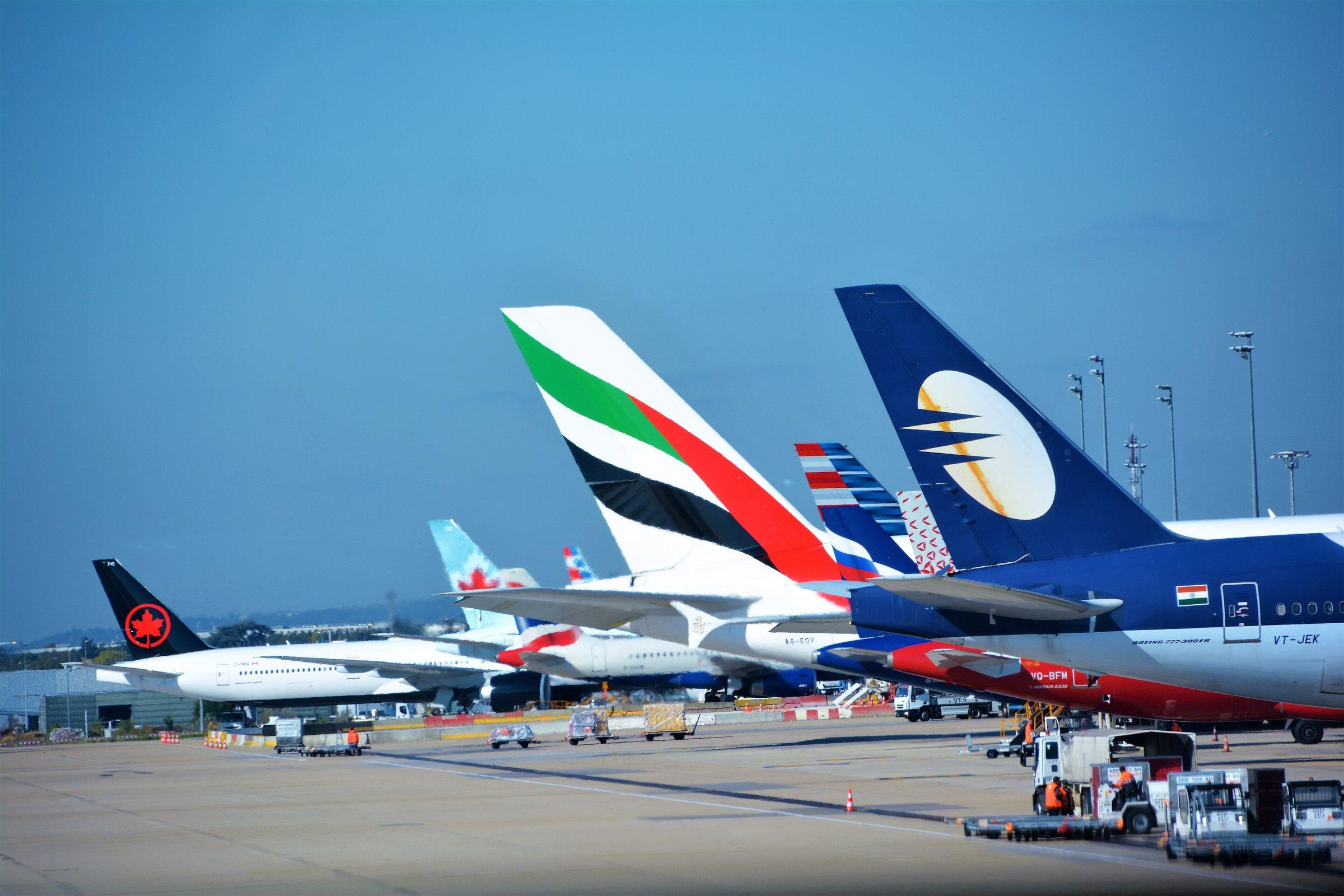
Dubai, Doha and Singapore have major airlines whose flight schedules are planned around their airports, making it easier for passengers arriving from one country to connect to flights going to another. These airlines coordinate their routes, flight timings and partnerships to help passengers reach more destinations through a single airport.
India also has a large domestic market that can bring passengers from smaller cities onto international flights. But, this opportunity is spread across different airlines and airports.
For example, a passenger arriving in Delhi can’t connect to a departing flight from Mumbai as if both airports were one hub. Are the flights timed and connected in ways that make journeys through India convenient and reliable?
3.3 Transfer Quality#
India scores 3.2/5 on transfer quality, compared with Dubai (3.8), Doha (3.7) and Singapore (4.0). However, these scores are based on limited comparable data, so the differences should be treated as indicative.
Delhi Airport handled 670,000 East–West–East transit passengers between September 2024 and August 2025, up 34% year on year. Within the reported East-to-West transit flow, Air India accounted for 67% and IndiGo for 25%, according to the airport operator. This suggests that Delhi is attracting more connecting passengers and that Indian airlines are participating in this growth.
For passengers, transfer quality comes down to how easy it is to change flights. Can they book the entire journey on one ticket? Will their baggage reach the final destination without them collecting it midway? Will the airline help them if a delayed flight causes them to miss their connection? Are the transfer routes easy to follow, and are there long waits for security or immigration? Even if an airport is ideally located, passengers may choose another hub if changing flights there is easier, faster and more reliable.
3.4 Airline Execution#
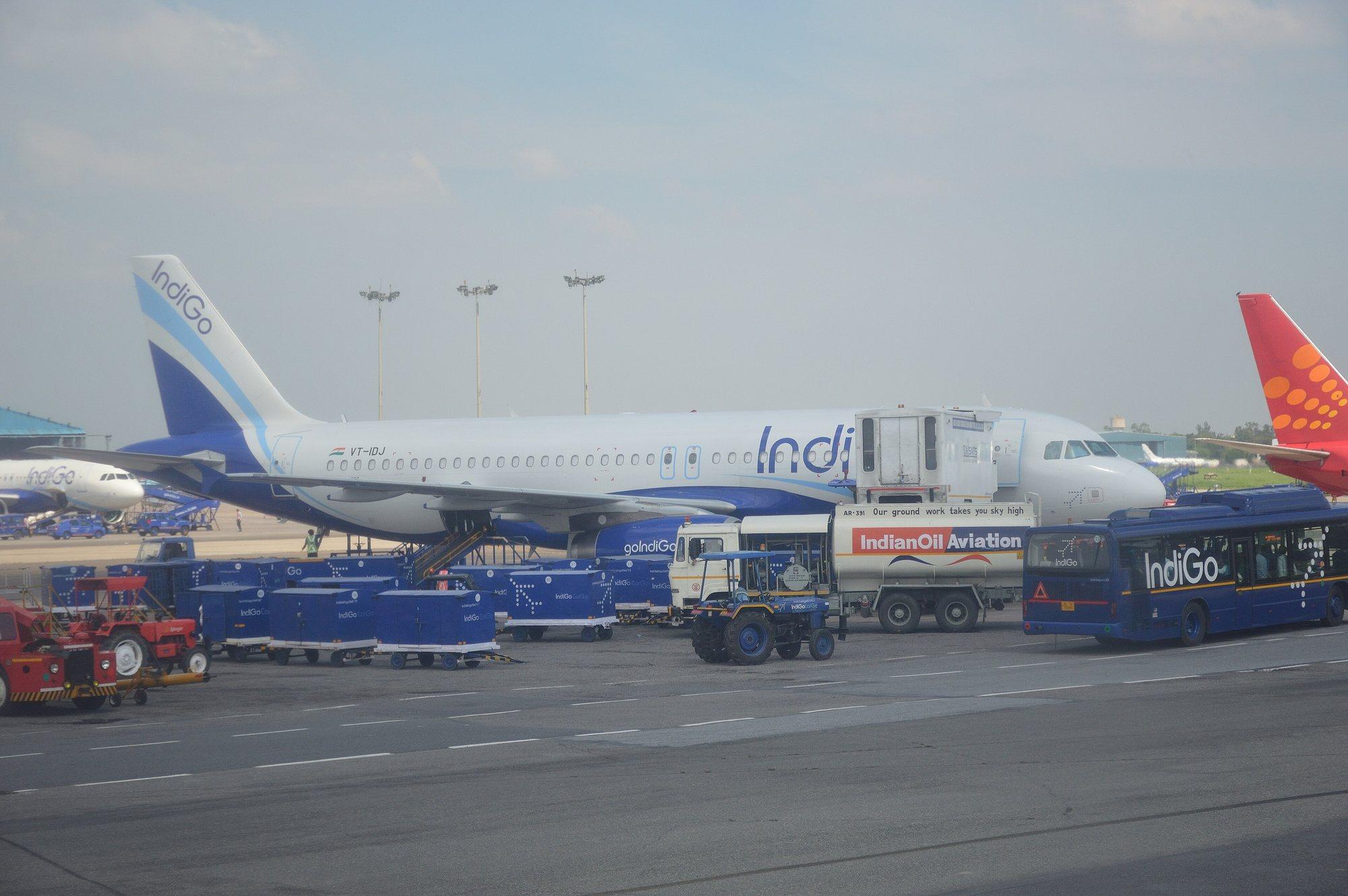
IndiGo reported 434 aircraft, over 2,200 daily flights, more than 118 million passengers, 40 international destinations and ten codeshare partners in FY2024–25. Air India also provides long-haul flights and access to a global airline alliance. These are important strengths that India can build on.
Airlines need enough aircraft available to operate their planned flights, suitable aircraft for long-distance routes, well-timed arrivals and departures, reliable operations and partnerships that make it easy for passengers to connect. They also need routes that can generate enough revenue to cover their costs throughout the year. Aircraft orders and announced expansion plans do not guarantee that the aircraft will be available and operating on schedule.
Dubai, Doha and Singapore perform better because their major airlines organise their networks around connecting passengers through their main airports. Their flight timings, long-distance routes, connections from other cities and airline partnerships work together to make these airports useful hubs.
3.5 Commercial Outcomes#
India scores 3.0/5 on commercial outcomes, compared with Dubai (4.5), Doha (4.4) and Singapore (4.3). The underlying data show a more nuanced picture than these scores alone suggest. Delhi is already demonstrating that Indian airlines can capture connecting traffic.
This is a concrete sign that domestic carriers can capture transfer demand when the network supports it, although the figures cannot be extended to all transfers at Delhi or elsewhere in India. (I have modelled Delhi’s cost advantage as part of this article, do check it out! Link)
3.6 Regulation and Infrastructure#
Government policy affects how airlines operate internationally. Bilateral air service agreements determine which airlines can operate between countries, which routes they can serve and how much capacity they can offer. India’s Ministry of Civil Aviation manages these agreements and the allocation of traffic rights. However, restrictions on foreign airlines should not automatically be blamed for India’s weaker hub performance. A restriction is a genuine obstacle only if airlines are using most of their permitted capacity, additional passenger demand exists, and they cannot add flights to serve it. Aircraft availability, airport slots, staffing and route profitability must also be considered. (Check out this article to see impact of bilateral seat agreements between UAE and India on Indian Airlines: Link)
The infrastructure comparison reveals more concrete differences. Delhi has a reported annual passenger-handling capacity of 109 million, giving it considerable nominal capacity on an annual basis. Mumbai, by contrast, handled 55.12 million passengers in FY2024–25 against a stated terminal capacity of 55 million, while an official government statement has also identified congestion in Mumbai’s airspace and slot-management processes. This suggests that Mumbai faces a more immediate capacity challenge, although annual passenger figures and terminal capacity do not capture every operational bottleneck. Among the benchmark hubs, Dubai handled 95.2 million passengers in 2025 and was described by its airport operator as operating close to its physical capacity. Doha increased its annual handling capacity to more than 65 million after opening its D and E concourses in March 2025. Singapore’s existing terminals have a stated capacity of 90 million passengers annually, with Terminal 5 expected to add another 50 million in the mid-2030s; that future capacity is not yet operational.
These figures suggest that India’s two main gateways face different infrastructure challenges: Delhi has substantial stated annual terminal capacity, while Mumbai faces more evident congestion and capacity pressure. But terminal capacity is only one part of hub competitiveness. An airport can accommodate millions of passengers without offering well-timed connecting flights, smooth baggage transfers or enough peak-hour slots for airlines to expand their networks. Similarly, a new terminal does not guarantee that airlines will operate the long-haul routes needed to attract transfer passengers.
4. How the Leading Hubs Built Their Position, and What We Can Learn From Them#
The comparison suggests that successful hubs do not win on geography alone. They combine a useful location with an airline network, an airport capable of handling transfers, and a commercial model that makes connecting through the hub attractive. Dubai, Doha and Singapore achieve this through different models.
Dubai#
Dubai's model is built around Emirates, whose network and fleet have developed together with Dubai International Airport. The scale and composition of its fleet are central to this model. At 31 March 2026, Emirates reported 277 aircraft: all support a network designed around long-distance international travel and connecting passengers.
Fleet composition matters because a hub airline must do more than offer many routes. It must deploy aircraft capable of serving the distances and passenger volumes involved, coordinate arrivals and departures, and use its capacity sufficiently to support the cost of operating it. Widebody aircraft also involve substantial fixed and operating commitments, making utilisation, revenue management and network density commercially important.
Emirates' financial results indicate that this scale has been accompanied by strong commercial performance. For FY2024–25, the airline reported revenue of AED127.9 billion and profit after tax of AED19.1 billion, equivalent to a 14.9% profit margin on those figures. In FY2025–26, Emirates reported a 17.4% profit-before-tax margin.
The important point is not that a large fleet automatically generates high profits. It is that Dubai's established carrier combines widebody capacity, international network breadth and extensive commercial partnerships with the financial performance needed to sustain its operations. At FY2025–26 year-end, Emirates reported 32 codeshare and 117 interline partners, providing access to more than 1,700 cities beyond its own network. Partnerships extend its reach, although partner counts alone do not establish that every itinerary is convenient or protected.
Dubai's model also illustrates why operating costs deserve attention. Fuel, airport and navigation charges, maintenance, crew, aircraft utilisation and disruption all affect the contribution earned from a route. An airline's ability to spread fixed costs across a large network and sell connecting itineraries can influence its commercial resilience.
So, my takeaway here is whether additional aircraft can support a coherent set of routes and connecting itineraries that generate sufficient revenue relative to their costs. Fleet growth can expand the opportunity, but the financial return depends on how that capacity is deployed.
Doha#
Doha illustrates a different version of the anchor-carrier model. Qatar Airways and Hamad International Airport are organised around a concentrated international connecting operation, supported by a substantial long-haul network.
The AHCF gives Doha a provisional airline-execution score of 4.9/5, the highest among the benchmark markets. Qatar Airways Group reported more than 300 aircraft and 183 destinations in FY2025–26. It also reported revenue of QAR83.75 billion and operating profit of QAR15.2 billion, implying an operating margin of approximately 18.1% from those figures.
These numbers provide evidence of scale and financial performance, but they need careful interpretation. The fleet and financial results are group-level measures, not a complete picture of Qatar Airways' individual route economics. The margin also cannot be compared mechanically with Emirates' profit-before-tax margin because the measures and accounting scopes differ.
Doha's position in OAG's connectivity ranking adds a useful qualification. Hamad International Airport ranks 46th in the 2026 Megahubs index, below Delhi at 28th. Yet Doha scores highly on the AHCF's airline-execution dimension. OAG measures potential connections from published schedules, whereas the AHCF's airline-execution assessment considers broader evidence about fleet capability, international deployment, partnerships and operational and financial resilience. Neither measure proves how many passengers actually transfer or whether every connection is profitable.
The distinction demonstrates why a hub cannot be assessed using a single ranking. An airport can have fewer schedule-based potential connections than another airport while supporting a highly coordinated operation built around a central carrier. Conversely, a high connectivity ranking does not establish that an airline can serve all those connections reliably and profitably.
For India, the relevant lesson is that network assets must function together. Domestic feeder services, long-haul routes, departure timings, aircraft availability and airline partnerships need to support practical connecting journeys. India has many of these components, but they are distributed across different carriers and operating systems. The existence of domestic feed and international flights does not mean passengers can automatically use them as one integrated product.
Singapore#
Singapore ranks 11th in OAG's 2026 Megahubs index and scores 4.0/5 for transfer quality in the AHCF. These results are consistent with a mature connecting operation, although the AHCF's transfer-quality score remains indicative because comparable transfer-time, satisfaction and missed-connection data are incomplete.
The Singapore example also highlights the need to distinguish current operating capability from planned investment. Changi's existing terminals have a stated annual capacity of 90 million passengers, with annualised utilisation estimated at around 70% for January–November 2024. Terminal 5 is planned to add another 50 million passengers of annual capacity, but this is future infrastructure rather than capacity already available. Annual terminal headroom also does not establish that every peak-hour runway, stand or terminal process is unconstrained.
Beyond physical capacity, Singapore's model highlights the commercial role of the airport itself. Changi Airport Group reported operating revenue of S$3.071 billion in FY2024–25, reflecting growth in passenger traffic and connectivity. The Singapore Ministry of Transport also states that aviation contributes approximately 5% of Singapore's GDP and directly employs more than 60,000 people.
These figures describe different economic outcomes. Airport-group revenue is not the same as airline revenue, and the wider economic contribution of aviation is not revenue captured by the airport or its airlines. Nor can the national economic contribution be attributed solely to transfer passengers. The measures nevertheless illustrate why hub performance can matter beyond the sale of airline tickets: airport operations and commercial activity form part of a wider aviation ecosystem.
For India, Singapore's relevance lies in treating the transfer experience as part of the product being sold. Through-ticketing, baggage arrangements, clear transfer routes, predictable security procedures and effective disruption recovery can determine whether a scheduled connection is genuinely useful. These features must be assessed through operational evidence, rather than assumed from the presence of modern terminals or a broad route network.
5. So, What Might an India Geographic Hub Strategy Look Like?#
I think we need not replicate Dubai, Doha or Singapore as it is; we could develop a hybrid model centred on Delhi as an anchor hub, using domestic feeder traffic to support selected international routes while allowing Mumbai to serve complementary markets where its demand and operating constraints justify a separate network. A collaboration between different airports, I suppose.
Alternatively, Air India’s long-haul capabilities and global partnerships, combined with IndiGo’s domestic scale and growing international reach, could extend the range of bookable connections through partnerships, provided schedules, baggage arrangements and disruption management work across the journey. A strategic alliance, or a codeshare agreement. I don't think we can expect to see this anytime soon though. Given that the market currently resembles as duopoly, a strategic alliance would need to be very heavily monitored by the government.
A third possibility is to compete primarily on transfer quality, making Indian gateways so convenient and reliable that passengers prefer them over alternative hubs. Play on customer demand, and I think this is a more singular airport level strategy.
Each model carries different risks: sure, concentrating traffic in Delhi may expose the network to capacity and operational constraints; splitting activity between Delhi and Mumbai could dilute connectivity; partnerships could expand nominal reach without generating profitable traffic. The appropriate choice depends on the origin–destination markets we can realistically capture, the aircraft and airport capacity available, and whether incremental connecting revenue can cover the costs of serving it.