India–Dubai Flight Seat Caps: Do They Protect Indian Airlines?
Bilateral seat caps give Indian airlines protected room to grow. A Delhi–Dubai model asks how much of that opportunity they actually convert.

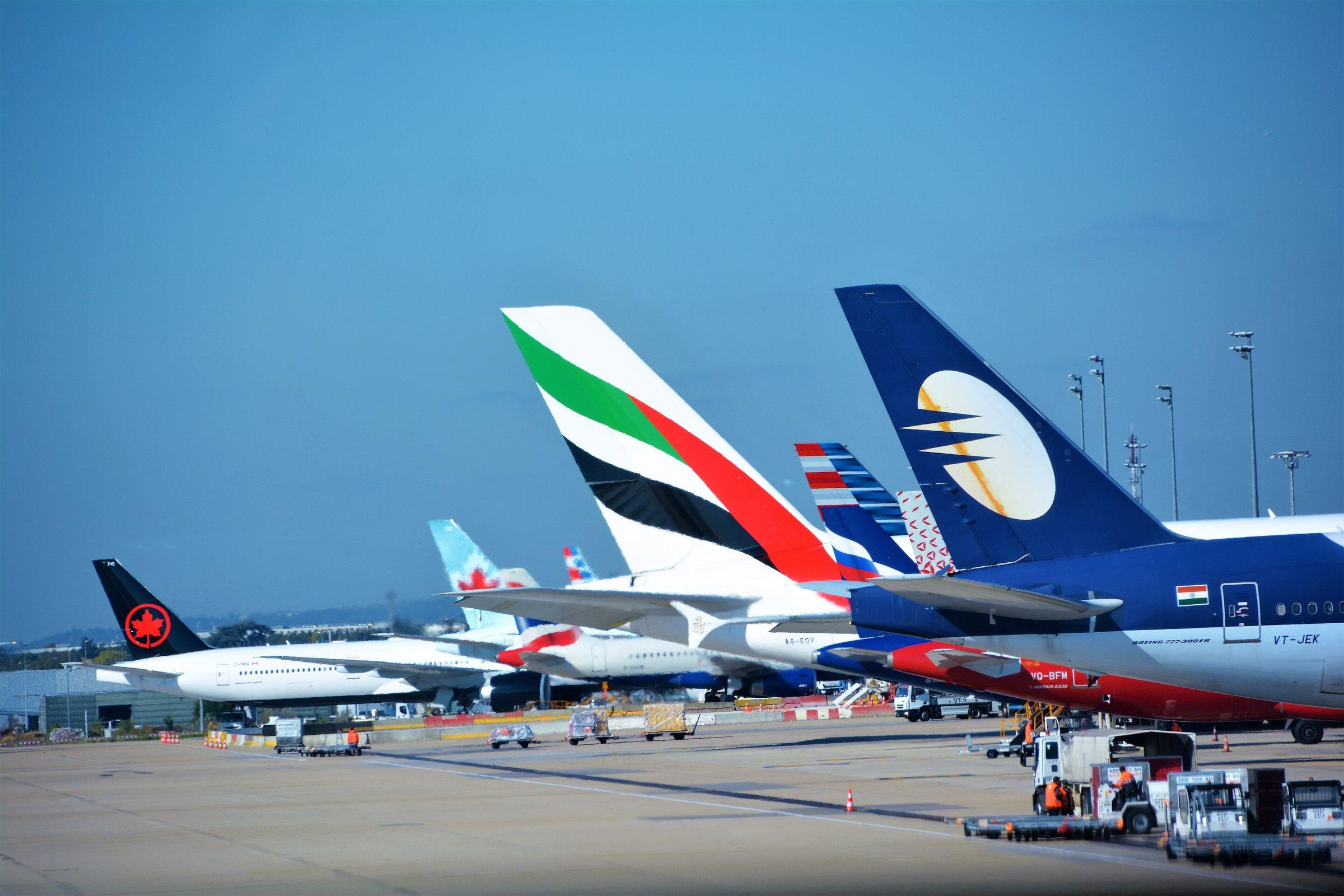
Photo: Charles from Port Chester, New York · CC BY 2.0
On this page
India's international aviation market is growing rapidly. But access to that market is not determined by demand alone. For international routes, airlines also need traffic rights negotiated between governments. These bilateral Air Services Agreements determine how much capacity designated airlines from each country can operate.
The India–UAE relationship is one of the clearest examples.
Under the 2014 India–UAE arrangement, the working figure for Dubai is approximately 66,000 seats per week in each direction. The exact historical entitlement has been recorded as 66,504 seats per week per side; this article uses 66,000 as a rounded working ceiling.
This capacity restriction is partly to give Indian airlines protected room to grow. But a protected foreign seat does not automatically become an Indian seat. It becomes an opportunity. The question is whether Indian airlines can actually convert that opportunity into aircraft, seats, passengers, revenue and eventually stronger international capability? That is the question this article investigates.
So, what exactly is India protecting?#
A bilateral seat entitlement is effectively a supply restriction. Even when passengers want to travel and airlines want to sell more tickets, additional capacity cannot simply be added once the bilateral entitlement has been exhausted.
The India–Dubai market has been at or close to this constraint for years. Emirates has repeatedly said that it has exhausted its available bilateral rights and wants additional capacity. In 2023, Emirates' president called India's refusal to expand Dubai rights “very vexing”; by 2025, the airline was again publicly arguing that demand exceeded the available bilateral capacity.
Indian airlines have historically been concerned about additional Gulf capacity — Air India raised concerns about the increase in bilateral seats to Dubai and Abu Dhabi in 2014, and more recently Indian carriers including IndiGo have backed maintaining restrictions while they expand their own fleets. Newer Indian entrants have taken a somewhat different view: Akasa Air has argued that exhausted bilateral rights prevent it from accessing markets such as Dubai, and that indefinite restrictions could leave Indian passengers facing higher fares. The disagreement therefore reflects different commercial positions.
Why India–Dubai?#
I find this market particularly interesting because it brings the protection-versus-competition question into a very concrete setting. Dubai is one of India's largest international aviation markets. The UAE was India's single largest international country market in 2024, accounting for approximately 7.6 million origin–destination passengers, or 19.9% of India's international passenger traffic. It is also a major connecting hub: passengers travelling from India through Dubai may ultimately be travelling onward to Europe, North America and other destinations. Dubai airport handled 11.9 million passengers from India in 2025, making India its largest country market, while Mumbai–Dubai and New Delhi–Dubai were among the busiest international routes from India. The likely rationale is essentially to give Indian carriers protected room to build international scale before exposing them to unlimited competition from large foreign hub carriers such as Emirates. The protection India is seeking is not just higher market share today, but time and demand to build more aircraft, international routes, long-haul networks, passenger share and financially sustainable international operations—so that Indian airlines become strong enough to compete on a more equal footing when foreign capacity eventually expands.
Because current bilateral seat quotas are already fully utilized by major carriers like Emirates, Etihad, and IndiGo, airlines cannot easily add more flights. Tourism Economics, an Oxford Economics company, projects that if current capacity limits hold, roughly 27% of forecast India–UAE passenger demand could go unserved by 2035 — a cumulative shortfall of about 54.5 million passenger journeys between 2026 and 2035, including 13.2 million on the Abu Dhabi–India corridor alone. The same study projects demand growing at 7.2% a year through 2035.
One qualification up front. The connecting traffic is arguably the biggest stake, and my model does not capture it. Government officials have said that around 70% of India's international flyers connect through Gulf hubs [1], and Emirates says that 84% of its India traffic in 2024 was on routes no Indian airline serves directly [2] (an interested party, so I treat it as a claim rather than neutral data). A Delhi–Dubai point-to-point model sees only part of what the cap protects.
I want to evaluate, when the government restricts foreign capacity to protect domestic airlines, how much of the protected opportunity is actually captured by domestic airlines?
The infant-industry argument#
The infant-industry argument is generally associated with Alexander Hamilton's early defence of protecting emerging American manufacturing, and was developed further by Friedrich List. John Stuart Mill later gave the argument a more conditional formulation: temporary protection could be justified where an industry had the potential to become competitive but had not yet accumulated the necessary skills and experience.
An established foreign competitor may have: greater scale or more experience, stronger networks, lower costs, better technology, and accumulated organisational capability. A younger domestic industry may therefore struggle to compete immediately. Temporary protection can, in theory, give the domestic industry time to learn, invest and reach a scale at which it can compete without protection. But the industry eventually has to become capable of competing without the protection.
Have we reached a place where Indian aviation can convert capability if protection is removed? If India restricts Emirates or other foreign carriers so that Indian airlines have more room, we should eventually be able to observe some form of capability being created through more aircraft; more international routes; greater international passenger share; stronger long-haul networks; sustainable route economics; and ultimately an ability to compete when foreign capacity is expanded.
Two things complicate the “infant” label. The Indian sector is not young. IndiGo alone accounts for about half of all scheduled seats in India, and Air India is a legacy carrier. And the cap has been in place since 2014, and as far as I can tell its without a sunset date or a utilisation condition. The classical test, Mill's idea as later formalised by Bastable, asks whether the eventual benefits of protection outweigh its costs. I do not run that full test here.
I split this policy into four questions.
- How large is the market opportunity being protected?
- How much of that opportunity are Indian airlines actually capturing today?
- If the capacity constraint were relaxed, how much additional traffic could the market absorb, and what would happen to fares?
- How much additional revenue and profit could Indian airlines potentially capture?
Methodology#
I use a bottom-up Delhi–Dubai model, outbound only (Delhi to Dubai). It is built flight by flight from the October 2026 nonstop schedule: aircraft seats × weekly flights × an assumed load factor gives passengers, and an assumed one-way fare gives revenue.
Where things stand today (questions 1 and 2)#
The model puts Delhi–Dubai outbound at about 20,067 passengers a week and ₹1,988 crore a year in revenue. Indian carriers (IndiGo, Air India and SpiceJet) carry about 10,396 of those passengers, a 51.8% share and ₹962 crore of revenue. UAE carriers (Emirates and flydubai) carry the other 48.2% and ₹1,026 crore.
That 51.8% is modelled, not observed. I could not find a published route-level seat or passenger split for India–Dubai. As a cross-check, Indian carriers operate 61.5% of the weekly flights in my model, against 63.5% of all India–Dubai weekly flights as of March 2025 (342 Indian-carrier flights against 197 by Dubai carriers, per Emirates). Delhi is also only a slice of the cap: Indian carriers offer about 12,446 seats a week on this route, roughly 19% of the 66,504 national entitlement.
What happens if capacity rises 5% (questions 3 and 4)#
A 5% rise adds about 1,003 passengers a week. Using the ORF/UAE Embassy estimate of roughly a 0.2% fall in fares for every 1% rise in passenger volume [4][5], the fare falls by about 1%: from ₹19,049 to ₹18,859 route-wide, and from ₹17,799 to ₹17,621 for Indian carriers.
The important detail is that this fare cut applies to every passenger, including the ones Indian carriers already carry. It costs them about ₹9.6 crore a year. So Indian carriers do not simply gain from new traffic; they gain only to the extent that new passengers outweigh that dilution. I do not assume a share of the new traffic. I show three: 19% as a stress case, 25%, and their current 51.8%.
| Share of new passengers won by Indian carriers | Revenue from new passengers (₹ cr/yr) | Fare cut on existing passengers (₹ cr/yr) | Net additional revenue (₹ cr/yr) | Indicative profit effect (₹ cr/yr) |
|---|---|---|---|---|
| 19% | 17.5 | (9.6) | 7.8 | (8.5) |
| 25% | 23.0 | (9.6) | 13.4 | (8.1) |
| 51.8% (current share) | 47.6 | (9.6) | 38.0 | (6.4) |
Net revenue is positive in all three cases, but the range is wide, and the more useful number is the break-even. Indian carriers need to win about 10.5% of the new passengers to be no worse off on revenue. That looks comfortable next to 51.8%, but it moves with the fare response. If fares fell by 0.5% for every 1% of extra capacity, the break-even rises to about 27%. At 1.0%, it is about 55%, above their current share, and Indian carriers would lose revenue even holding that share.
Revenue is not profit. The fare cut falls straight through to profit because it saves no cost, while a new passenger only earns a margin. Using IndiGo's FY26 EBIT margin of 6.7% as a proxy for the margin on new passengers, the profit effect is negative in all three cases. At their current share, Indian carriers would need to earn about 20% on new passengers to break even. I would not read this as saying that opening Delhi–Dubai would lose Indian carriers money: 6.7% is a crude proxy, and FY26 was an unusual year for IndiGo. The point is narrower. On this route, the gain depends on the share won and the margin earned, not on volume alone.
What this says about protection#
The model measures what Indian carriers would gain or lose if the cap were relaxed. It does not directly measure what the cap delivers to them. But it gives a first sense of scale. On the model’s numbers, holding capacity at the cap protects about ₹9.6 crore a year of fare dilution per 5% of capacity on this route, roughly 1% of Indian carriers’ ₹962 crore of revenue here. The other side of the same cut is a saving of about ₹19.9 crore a year for existing outbound passengers, roughly half of which comes from UAE carriers. These are small numbers on one route. The model’s value is the mechanism, not the figures.
So what could go wrong?#
- Aircraft availability. A bilateral entitlement cannot create aircraft. If Indian airlines do not have enough operational aircraft, the additional rights may simply remain unused, and the share they win falls towards the low cases above. Business Standard, citing government officials, reported that India’s widebody fleet has stagnated over the past 15 years. Unused entitlement has appeared before: Gulf News has reported that some weaker Indian airlines could not use their portion of the Dubai entitlement in full.
- The actual competitive split of incremental capacity. The model shows three shares, not one. 51.8% is where Indian carriers are today, but it is not guaranteed. If Emirates and other UAE carriers capture most of the incremental demand, the benefit to Indian airlines will be smaller, or negative. If Indian airlines capture more than their existing share, it will be larger.
- Fare response. The model uses the ORF/UAE Embassy relationship as the mechanism linking capacity to fare. It is an association between passenger volume and average fares on India–UAE routes as a whole, and the report was co-released by the UAE Embassy, which has an interest in more capacity [4][5]. If the actual Delhi–Dubai fare response is weaker, the fare reduction will be smaller. If it is stronger, the passenger benefit will be larger, and Indian carriers’ net revenue will be lower. The model also lets passengers rise by the full 5% while the fare falls by only 1%, which implies very elastic demand (roughly −5). If demand is less elastic, load factors would fall or fares would need to fall further.
- Starting fare. The flight-level model uses carrier-specific fare assumptions rather than an observed route-wide realised-yield series, and revenue scales directly with them. Actual booked fares vary by season, cabin, booking date and passenger type.
- Operating economics. With every additional plane, operating costs go up too. Fuel, leasing, maintenance, airport charges, crew costs, aircraft utilisation all determine how much of the incremental revenue ultimately reaches the bottom line.
Thailand: what happened when capacity was increased?#
Thailand provides a useful recent comparison because India and Thailand actually renegotiated their aviation rights.
In March 2024, Thailand and India agreed to increase capacity in two stages, with each stage adding 7,000 seats per week per side, on top of an existing entitlement of 32,000. That is a 44% increase in total, far larger than the 5% I model for Dubai. The agreement also opened four additional Thai destinations to Indian carriers, and Thailand's government presented it as part of its aviation-hub and tourism policy. The first additional allocation was scheduled from November 2024.
What matters for this article is utilisation. Reporting at the time said that Indian carriers other than SpiceJet were fully using their allotment, while the seats once held by Go First stayed unassigned after its closure. So even where the ceiling was lifted, some entitlement went unconverted.
Thailand is an imperfect comparator, because it has no Emirates-style hub carrier competing for India's onward traffic. I read it as evidence on conversion, not on competition. The policy-design lesson is that Thailand opened capacity in stages rather than treating the original ceiling as permanently fixed.
Conclusion#
A bilateral restriction creates protected market space.
That space only has strategic value if Indian airlines can convert it into aircraft, seats, passengers, revenue, profit and eventually durable international capability.
On the one route I modelled, the answer is more conditional than a headline revenue figure suggests. Relaxing the cap would add revenue for Indian carriers only if they win more than about a tenth of the new passengers, and would add profit only at margins well above the 6.7% I used, because more capacity also cuts the fare on every passenger they already carry.