From Scorched Mercury to Windswept Neptune: A Grand Tour of the Eight Planets
A guided tour of the Sun's eight planets, from rocky inner worlds to giant outer ones, and the story of why Pluto lost its planet status.

On this page
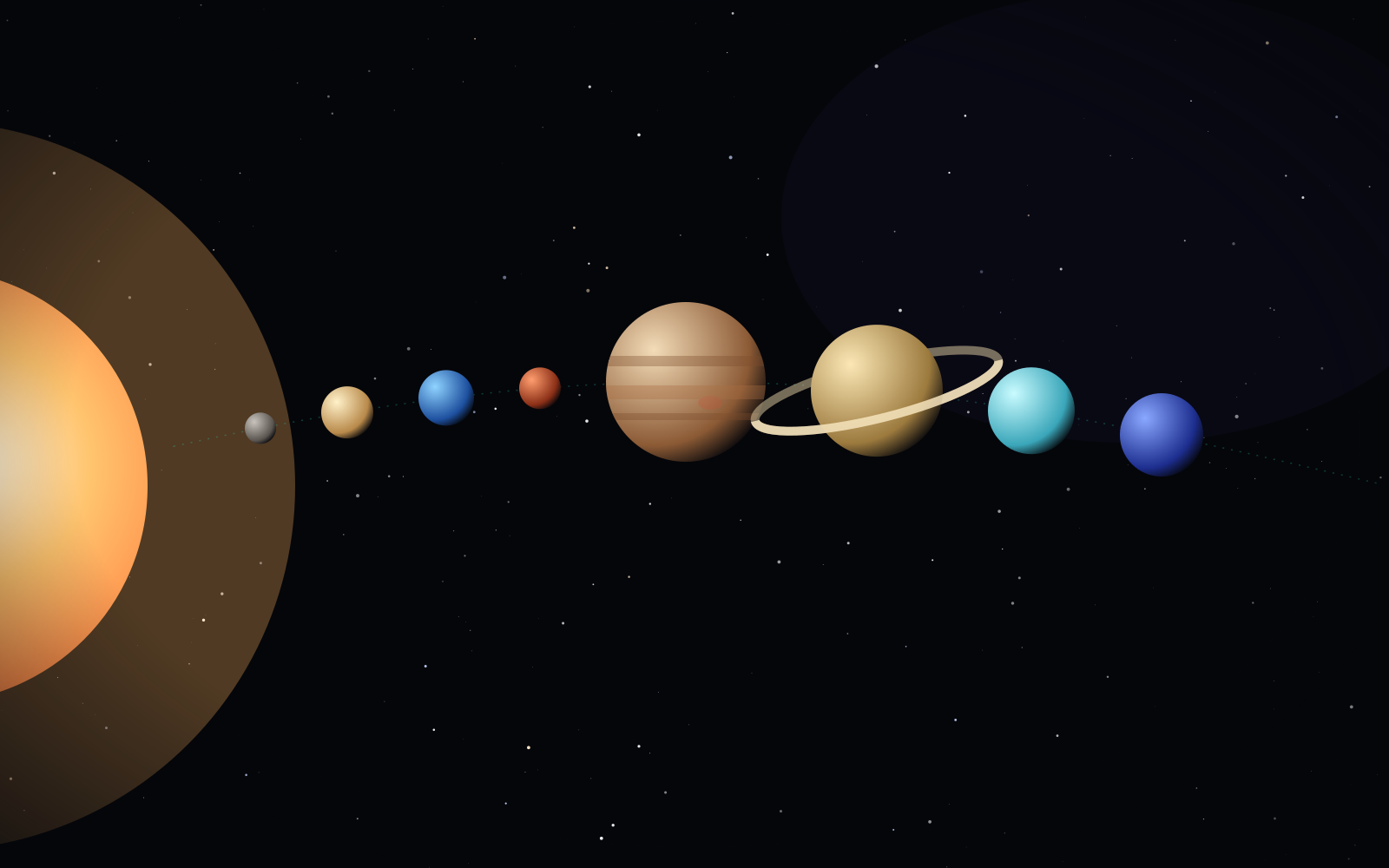
Our Sun is a fairly ordinary star, but it presides over an extraordinary family. It holds about 99.8% of all the mass in the solar system, and around it circle eight wildly different planets: a scorched cinder, a choking greenhouse, a living blue world, a rusty desert, and four giants wrapped in clouds and rings. Let's take a tour, from the Sun outward into the cold.
The Solar System at a Glance#
Astronomers measure solar system distances in astronomical units (AU). One AU is the average Earth–Sun distance, about 149.6 million kilometers. Sunlight takes a little over eight minutes to reach Earth and roughly four hours to reach Neptune.
| Planet | Type | Average distance from Sun (AU) | Known moons |
|---|---|---|---|
| Mercury | Rocky | 0.39 | 0 |
| Venus | Rocky | 0.72 | 0 |
| Earth | Rocky | 1.00 | 1 |
| Mars | Rocky | 1.52 | 2 |
| Jupiter | Gas giant | 5.20 | 95+ |
| Saturn | Gas giant | 9.54 | 270+ |
| Uranus | Ice giant | 19.2 | About 29 |
| Neptune | Ice giant | 30.1 | About 16 |
Moon counts are as of the mid-2020s and keep climbing as telescopes find ever smaller moons, so treat them as snapshots.
The planets fall into three families: small rocky worlds near the Sun, gas giants in the middle, and ice giants in the cold outer reaches. Where a planet formed shaped what it became.
The Rocky Inner Worlds#
The four inner planets are small worlds of rock and metal, each with its own story:
- Mercury is the smallest planet, racing around the Sun every 88 days. With almost no atmosphere to hold heat, its surface swings from about 430 °C by day to around −180 °C at night, yet ice survives in permanently shadowed polar craters. The European–Japanese BepiColombo mission is due to enter orbit around it in late 2026.
- Venus is nearly Earth's twin in size but nothing like it in comfort. Its thick carbon dioxide atmosphere traps so much heat that the surface sits around 465 °C, hotter than Mercury, under about 90 times Earth's air pressure and clouds of sulfuric acid. It spins backwards, so slowly that one rotation (about 243 Earth days) outlasts its year (about 225 days).
- Earth is the only place known to host life, thanks in large part to liquid water and a mild atmosphere. Our unusually large Moon helps steady the tilt of Earth's axis.
- Mars is about half Earth's width, with surface air pressure under 1% of ours. It boasts Olympus Mons, a volcano roughly two and a half times the height of Mount Everest, and a canyon system about 4,000 kilometers long. Ancient riverbeds show it was once wetter. Whether its small moons, Phobos and Deimos, are captured asteroids or debris from an ancient impact is still debated.
Beyond Mars lies the asteroid belt, home to the dwarf planet Ceres, and then the realm of the giants.
The Gas Giants: Jupiter and Saturn#
Jupiter#
Jupiter is more than twice as massive as all the other planets combined, and roughly 1,300 Earths could fit inside it. Its Great Red Spot, a storm wider than Earth, has been watched continuously since the nineteenth century. Astronomers in the 1600s recorded a large spot too, but a 2024 study argued it was probably a different storm.
Jupiter's four largest moons, discovered by Galileo in 1610, are fascinating worlds. Io is the most volcanically active body known. Europa likely hides a salty ocean beneath its ice, the target of NASA's Europa Clipper, due to arrive in 2030. Ganymede, the solar system's largest moon, is bigger than Mercury, and Callisto is among the most heavily cratered objects known.
Saturn#
Saturn is, on average, less dense than water. Its famous rings are made mostly of water ice, in pieces ranging from dust grains to chunks as big as houses. The main rings span more than 250,000 kilometers, yet in most places they are only about ten meters thick. Their age is debated: Cassini data suggested a few hundred million years, but some researchers argue they could be nearly as old as Saturn. Its moon Titan has a thick nitrogen atmosphere and lakes of liquid methane, while Enceladus sprays jets of water from an ocean beneath its icy crust.
The Ice Giants: Uranus and Neptune#
Uranus and Neptune are called ice giants, although their "ices" of water, ammonia and methane exist deep inside mostly as hot, dense fluids. Each has been visited only once, by Voyager 2, in 1986 and 1989.
- Uranus was the first planet discovered with a telescope, by William Herschel in 1781. It is tipped over by about 98 degrees, so it rolls around the Sun on its side. Over its 84-year orbit, each pole gets roughly 42 years of continuous daylight, then 42 years of darkness.
- Neptune was found in 1846 after mathematicians, most famously Urbain Le Verrier, predicted its position from tiny tugs on Uranus's orbit. Its winds reach around 2,000 kilometers per hour, the fastest measured on any planet. Its largest moon, Triton, orbits backwards and was probably captured from beyond Neptune.
Neptune is often pictured as much bluer than Uranus, but a 2024 reanalysis of the data found the two are actually similar, both a pale greenish blue.
What Happened to Pluto?#
Clyde Tombaugh discovered Pluto in 1930 at Lowell Observatory in Arizona, and for 76 years it was the ninth planet. But from the 1990s, astronomers began finding many more icy bodies in the Kuiper Belt beyond Neptune, and in 2005 they found Eris, roughly Pluto's size and somewhat more massive. If Pluto was a planet, it was hard to argue that Eris was not.
In August 2006, the International Astronomical Union adopted a formal definition. A planet must:
- orbit the Sun,
- be massive enough for its own gravity to pull it into a nearly round shape, and
- have cleared the neighborhood around its orbit.
Pluto passes the first two tests but fails the third. It became a "dwarf planet," alongside Ceres, Eris, Haumea and Makemake. The decision remains controversial, and some planetary scientists prefer a definition based on a body's own properties, under which Pluto would count. Whatever we call it, NASA's New Horizons flyby in July 2015 revealed a surprisingly active world, with mountains of water ice and a vast, heart-shaped plain of nitrogen ice.
Beyond the Eighth Planet#
The tour does not really end at Neptune. Past it lie the Kuiper Belt and, much farther out, the Oort Cloud, a vast shell of icy bodies that has never been directly observed. Some astronomers suspect an undiscovered "Planet Nine" lurks out there, though none has been found. Voyager 1, our most distant spacecraft, is now more than 160 AU from the Sun.
Our solar system is far stranger than the tidy textbook diagrams suggest, and every new mission adds another chapter.