The State of Aviation in India: More Airports, Fewer Flyers, Costlier Fuel
India has 165 airports and two new mega-hubs, but 2026 brought falling traffic, soaring fuel bills and a hard lesson in pilot fatigue rules.

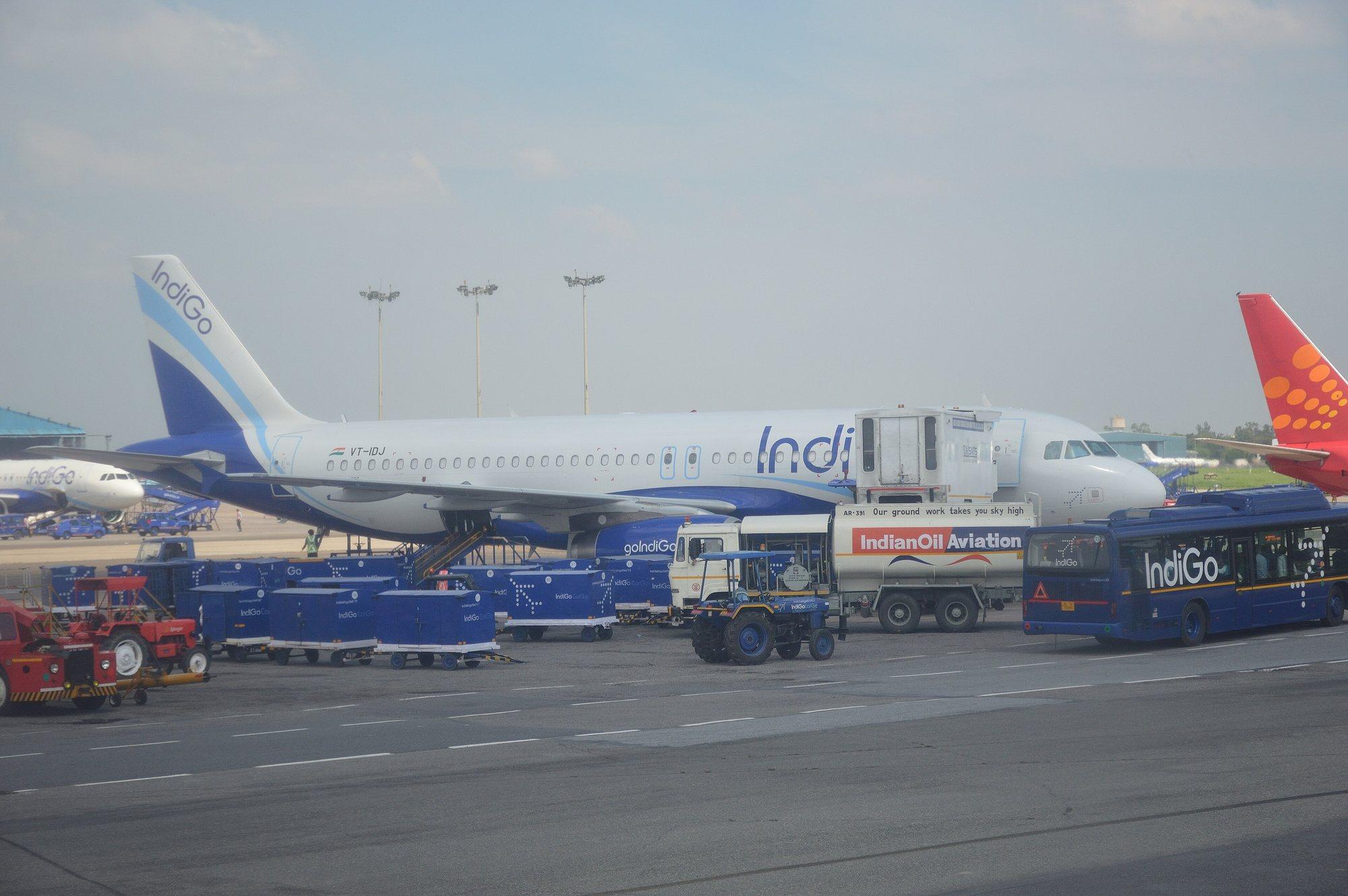
Photo: Biswarup Ganguly · CC BY 3.0
On this page
For most of the past decade, the story of Indian aviation ran in one direction: up. Passenger numbers climbed, new airports opened and airlines placed some of the biggest aircraft orders ever signed. In 2026 the line has gone flat. India has more airports than ever, and two long-awaited gateways near Mumbai and Delhi are finally open. Yet domestic airlines are carrying fewer passengers than a year ago. Fuel bills jumped after war broke out in West Asia, and the industry is still absorbing the lessons of a pilot-rostering breakdown in December 2025. This is where things stand as of late October 2026.
Passenger Demand: From Boom to Plateau#
India's domestic market grew fast after the pandemic, then slowed sharply. Based on Directorate General of Civil Aviation (DGCA) data, the Free Press Journal reports these totals for recent financial years (April to March):
| Financial year | Domestic passengers | Growth |
|---|---|---|
| FY2023-24 | 153.6 million | 13% |
| FY2024-25 | 165.5 million | 7.7% |
| FY2025-26 | 167.5 million | 1.2% |
Rating agency ICRA's count for FY2025-26 is almost the same: 1,677.4 lakh passengers (about 167.7 million), up 1.4%. Either way, growth almost stopped. The current financial year looks weaker still. Traffic fell year on year by about 1% in June, 4.8% in July and 6.3% in August, according to DGCA data compiled by ICRA. From April to August 2026, airlines carried 667.9 lakh passengers, against 674.9 lakh a year earlier.
Why are fewer people flying? Industry voices mostly blame the supply side, not a lack of interest. Gaurav Patwari, chief business officer at the travel platform Cleartrip, told The Core that "demand is not the problem". He pointed instead to fewer seats and higher fares. The same report found travellers booking later, cutting back on optional trips and, on some short routes, switching to trains.
Airports: A Network That Keeps Growing#
On the ground, expansion continues. According to the Press Information Bureau (PIB), India had 74 operational airports in 2014 and 165 as of 15 July 2026. A later PIB factsheet marking ten years of the regional scheme put the figure at 166, as reported by Indian Aviation News.
Much of that growth came through UDAN (Ude Desh ka Aam Nagrik, "let the common citizen fly"), the regional connectivity scheme launched in October 2016. It subsidises flights to small and underserved airports.
According to PIB, as of 15 July 2026 UDAN had operationalised 679 routes connecting 95 airports, heliports and water aerodromes, with more than 3.58 lakh flights carrying over 1.68 crore passengers. By October 2026 the government counted 687 routes and 1.72 crore passengers.
Its successor, Modified UDAN, was launched on 4 July 2026. It runs from FY2026-27 to FY2035-36 with a total budget of ₹28,840 crore. The plan includes ₹12,159 crore to turn 100 unused airstrips into working airports, ₹3,661 crore for 200 modern helipads, and ₹10,043 crore of viability gap funding for airlines that fly thin regional routes.
At the other end of the scale, two big-city airports opened within six months of each other:
| Airport | Milestone | Date |
|---|---|---|
| Navi Mumbai International | Inaugurated by Prime Minister Narendra Modi | 8 October 2025 |
| Navi Mumbai International | Commercial flights begin (IndiGo, Air India Express, Akasa Air) | 25 December 2025 |
| Noida International (Jewar) | Phase 1 inaugurated | 28 March 2026 |
| Noida International (Jewar) | First commercial flight, IndiGo 6E-2278 from Lucknow | 15 June 2026 |
Navi Mumbai is a public-private partnership between an Adani Airports Holdings subsidiary, which holds 74%, and the state agency CIDCO, which holds 26%. It opened with 16 domestic destinations and 12-hour operating days, with round-the-clock operations planned from February 2026. Noida International, built by an arm of Zurich Airport International, opened with IndiGo and Akasa Air. The Air India group was not operating there at launch.
A Market With Two Giants#
India's domestic market is now highly concentrated. September 2026 shares, based on DGCA data:
| Airline | Passengers (Sept 2026) | Domestic market share |
|---|---|---|
| IndiGo | 77.30 lakh | 65.4% |
| Air India group | 31.65 lakh | 26.8% |
| Akasa Air | 6.64 lakh | 5.6% |
| SpiceJet | under 1 lakh | 0.6% |
IndiGo and the Air India group together carried more than 92% of domestic passengers. SpiceJet's share halved, from 1.2% in August to 0.6% in September. The competitive picture, and what it means for passengers, is covered in a companion piece, How Indian Airlines Are Competing for the Future.
Fleets, Orders and Grounded Jets#
Airlines have kept adding aircraft despite the slowdown. IndiGo ended June 2026 with 432 aircraft, including three freighters and seven aircraft leased with crew, six of them Boeing 787s. It served 97 domestic and 46 international destinations. The Air India group announced orders for 470 aircraft in 2023, split between Boeing and Airbus. It followed with 100 more Airbus jets in December 2024 and 30 more Boeing 737 MAX aircraft in January 2026. Akasa Air plans a fleet of 226 Boeing 737 MAX jets.
Not every aircraft is flying, though. ICRA estimated that around 99 aircraft were grounded as of March 2026, or 11–13% of the industry fleet. That was down from 20–22% in September 2023. Supply-chain shortages and problems with Pratt & Whitney engines continue to limit capacity.
Pressure Points: Pilots, Fuel and Taxes#
The pilot-fatigue rules and the December meltdown#
In January 2024 the DGCA revised its Flight Duty Time Limitation (FDTL) rules to reduce pilot fatigue. Weekly rest rose from 36 to 48 hours. "Night" was redefined as midnight to 6 am, an hour longer than before, and the limit on night landings fell from six to two. After delays, the revised norms came into effect on 1 November 2025.
Weeks later, IndiGo's operations broke down. A DGCA inquiry found that between 3 and 5 December 2025 the airline cancelled 2,507 flights and delayed 1,852, affecting more than three lakh passengers. The committee blamed over-optimised operations, crew rosters with minimal recovery margins and inadequate buffers during the move to the new rules. It also found that senior management failed to anticipate the impact of the winter 2025 schedule.
The government also ordered IndiGo's winter schedule cut by 10% in December 2025, so that its flights matched the pilots it had available.
Fuel, war and the rupee#
On 28 February 2026, US and Israeli strikes on Iran triggered airspace closures across much of the Gulf region. For Indian airlines, that meant longer routes, lost Gulf traffic and a sharp rise in aviation turbine fuel (ATF) prices. ICRA estimates that ATF prices were 24.7% higher year on year in August and 33.4% higher in September 2026.
The Federation of Indian Airlines, whose members include Air India, IndiGo and SpiceJet, says fuel now makes up about 55–60% of operating costs, up from 30–40%. That explains the industry's long-running complaint about ATF taxation. The federation has asked the government to:
- replace the 11% ad valorem excise duty on domestic ATF with a fixed-rate duty;
- price domestic ATF on a cost-plus basis instead of an international benchmark;
- keep the 7% VAT rate on ATF in Delhi and Maharashtra beyond mid-November, and cut VAT in Tamil Nadu, West Bengal, Karnataka and Telangana.
The government has already introduced a 25% cut in landing and parking charges, a ₹5,000 crore emergency credit line and a ₹10,000 crore ATF price stabilisation fund.
The impact shows up in airline accounts. In the April–June 2026 quarter, IndiGo's fuel expenses rose 85.7% to ₹10,833 crore. The average exchange rate also weakened from ₹85.29 to ₹95.02 per US dollar. IndiGo, the market leader, reported a net loss of about ₹238 crore for the quarter, against a profit of about ₹2,176 crore a year earlier.
What Comes Next#
The government's long-term view is more expansive. PIB describes India as the third-largest domestic aviation market in the world. Its UDAN anniversary factsheet says aviation employment grew from about 3 million in 2014 to nearly 7.7 million in 2026, and could reach 25 million by 2040. These are government projections, not independent forecasts.
Conclusion: Building for a Future That Arrived Slower Than Planned#
India's aviation system in late 2026 is full of contradictions. It has more airports than ever, a regional scheme renewed for another decade and two new metropolitan gateways. It also has falling domestic traffic, fuel costs that have turned profits into losses, and a regulator that had to discipline the country's biggest airline over a crisis that began with pilot rest rules.
None of this cancels the long-term case for growth, which rests on a large population that still flies relatively little. But 2026 has shown how sensitive that growth is to things outside any airline's control, such as oil prices, airspace closures and the rupee. It has also shown that rules meant to make flying safer require proper planning by the airlines that must follow them. The next test is the winter season, when the industry will see whether the September slide was a pause or a trend.